

AMOLF researchers with granted NWO XS projects
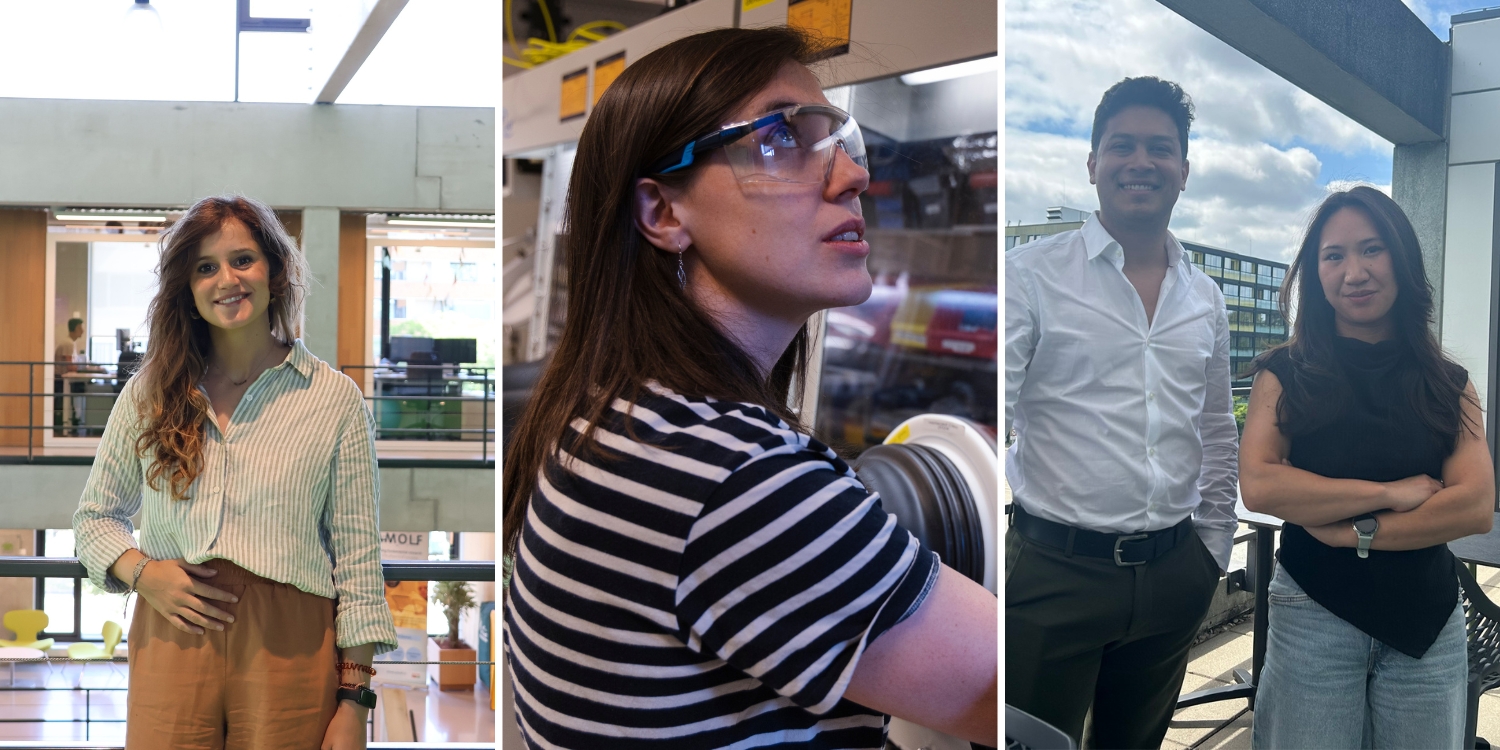
Last week, three AMOLF researchers learned that their research projects had been awarded funding through the Open Competition Domain Science-XS call. They are Dr. Susanna Eli (Biophysics, Quant. Dev. Biology & Physics of Cellular Interactions), Dr. Sarah Gillespie (Nanoscale Solar Cells), and Dr. Sergio Rey Puentes (Hybrid Nanosystems).
The projects focus on three quite different topics, namely: building the next-generation organoids, understanding cellular interactions and controlling chemical reactions with light.
Building the next-generation organoids
Susanna Eli
How tissues maintain the right mix of cell types in the right place is a fundamental question in biology. The fate of a cell depends not only on what type of cell it is, but on where it is located, yet current organoid technology ignores this spatial dimension entirely. Working within the Autonomous Matter department, this project investigates how epithelial tissues self-organize and how signals from the surrounding environment reshape that process by remodeling the landscape in which cells make their decisions. To study this, a platform will be developed that works like a controlled neighborhood: living signal sources are placed at specific locations beneath an intestinal epithelial layer, and each cell is followed over time to see how its position shapes what it becomes. This will provide a tool for building next-generation organoids, with direct relevance for cancer and inflammatory bowel disease research.
Understanding cellular interactions using solar cell techniques
Sarah Gillespie
Immunotherapy for cancer treatment is built on understanding cellular interactions at a fundamental level; this requires powerful, quantitative characterization techniques. Photoluminescence (fluorescence) spectroscopy is particularly useful, since it is a non-invasive approach to probe dynamic processes in living systems. But living cells are extremely complex. Recently, we developed a quantitative technique called IMPLS to study similarly complex kinetics in solar cells. In this project, we propose to transfer IMPLS to biophysical systems. Specifically, we aim to directly quantify cellular dynamics and interactions in white blood cells, and ultimately establish a new optical approach with huge potential to advance immunotherapy research.
Sarah likes the fact that the project brings together two very different areas of expertise at AMOLF namely: the Nanoscale Solar Cells (group leader Erik Garnett) and the Physics of Cellular Interactions (group leader Kristina Gazinger). She says: “Although the two groups belong to different research themes at AMOLF, the project shows how we can meet over coffee, ask questions, share our thoughts and create new and exciting ideas. This of course really reflects the open and collaborative nature of AMOLF.”
Controlling chemical reactions with light
Sergio Rey Puentes
Imagine controlling not just whether a chemical reaction happens, but which reaction happens, simply by choosing the color of light. Together with colleague Quynh Nguyen, Sergio will explore that idea using gold nanorods: tiny particles that respond differently to green and red light. Green light can drive oxidation, while red light can favor reduction on the same particle in solution. By testing and combining these processes, we aim to show that light colour alone can guide chemical outcomes — demonstrating that a single nanoparticle can do what nature needed two entire photosystems to achieve: independently control both the oxidative and reductive sides of a chemical reaction using nothing but light.
Sergio and Quynh believe that such flexibility is advantageous. “It can reduce chemical waste and the amount of energy required to drive chemical reactions. This all amounts to a new, more sustainable way of doing chemistry.”
Learn more
If you have questions about the projects, then contact the researchers directly by email: Susanna Eli, Sarah Gillespie and Sergio Rey Puentes.
To learn more about the research carried out in the groups of the grant recipients, visit the group pages:
- Susanna Eli: Physics of Cellular Interaction, Biophysics and Quantitative Developmental Biology
- Sarah Gillespie: Nanoscale Solar Cells
- Sergio Rey Puentes: Hybrid Nanosystems
