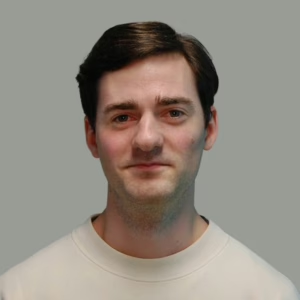
Sander Tans leads the biophysics research group at the AMOLF institute in Amsterdam since 2002, and heads the Autonomous Matter Department there since 2020. In 2009, he was also appointed professor in molecular and cellular biophysics at Delft University of Technology in 2009, within the department of Bionanoscience and the Kavli institute of Nanoscience. He obtained his PhD degree from Delft University of Technology in 1998. After a brief position at IBM, he continued as a post-doctoral fellow at the University of California at Berkeley.
His research is focused on single molecule and single cell biophysics. One key theme is how chaperones fold proteins and suppress protein aggregation, using single-molecule biophysics approaches. This work is extended to investigate chaperone-ribosome interactions and ubiquitin mediated protein degradation. A second key theme is to understand the dynamics of cell renewal and homeostasis in organoids, using AI-driven microscopy analysis approaches. One major question is how tissues like the intestinal epithelium can maintain all the various cell types in their proper proportions and adapt during disease despite the rapid underlying cell proliferation and renewal.
Highlight publications:
Epithelial tension controls intestinal cell extrusion - Krueger and Spoelstra et al., Science 389 (2025)
Interactions between nascent proteins translated by adjacent ribosomes drive homomer assembly - Bertolini et al., Science 371 (2021).
Bacterial coexistence driven by motility and spatial competition - Sebastian Gude et al., Nature 578, 588-592 (2020)
Processive extrusion of polypeptide loops by a Hsp100 disaggregase - Mario Avellaneda et al., Nature 578, 317-320 (2020)
Alternative modes of client binding enable functional plasticity of Hsp70 - Alireza Mashaghi et al., Nature 539, 448-451 (2016)
Stochasticity of metabolism and growth at the single-cell level - Daniel J. Kiviet et al., Nature 514, 376-379 (2014)
Reshaping of the conformational search of a protein by the chaperone trigger factor - Alireza Mashaghi et al., Nature 500, 98-101 (2013)
Tradeoffs and optimality in the evolution of gene regulation - Frank J. Poelwijk et al. Cell 146, 462-470 (2011)
Direct Observation of Chaperone-Induced Changes in a Protein Folding Pathway - Philipp Bechtluft and Ruud van Leeuwen et al., Science 318:1458-1461 (2007)
Empirical fitness landscapes reveal accessible evolutionary paths - Frank Poelwijk, Daan Kiviet et al. Nature 445:383-386 (2007)
The bacteriophage phi29 portal motor can package DNA against a large internal force - Douglas E. Smith, Sander J. Tans et al. Nature 413:748-52 (2001)
Molecular transistors: Potential modulations along carbon nanotubes - Sander J. Tans, Cees Dekker. Nature 404:834-35 (2000)
Imaging electron wave functions of quantized energy levels in carbon nanotubes - Liesbeth C. Venema et al. Science 283:52-55 (1999)
Electron-electron correlations in carbon nanotubes - Sander J. Tans et al. Nature 394:761-64 (1998)
Room-temperature transistor based on a single carbon nanotube - Sander J. Tans et al., Nature 393:49-52 (1998)
Individual single-wall carbon nanotubes as quantum wires - Sander J. Tans et al., Nature 386:474-77 (1997)
Fullerene ‘crop circles’ - Jie Liu et al. Nature 385, 780-781 (1997)