

New focus on physical learning as Nachi Stern receives NWO grant
AMOLF group leader Nachi Stern has received an NWO ENW-M1 grant to support his research project on how physical systems can learn. His research could help develop new types of energy efficient hardware for artificial intelligence. The Dutch Research Council (NWO) uses the ENW-M1 grant to fund high quality fundamental research driven by curiosity and important scientific questions.
When people talk about learning, they usually think about computers or the human brain. Nachi takes a broader view. “I like to think about learning from a physical perspective,” he explains. “It can also apply to things like smart materials and biological systems that do not have brains.”
Some physical systems, such as networks of electronic components or flexible materials, can adjust themselves to perform tasks. In a way, they can learn to solve problems based on the needs of the user, similar to how machine learning algorithms improve through training. The first experiments demonstrating this idea have only begun to show what these systems might be capable of.
How physical systems can learn
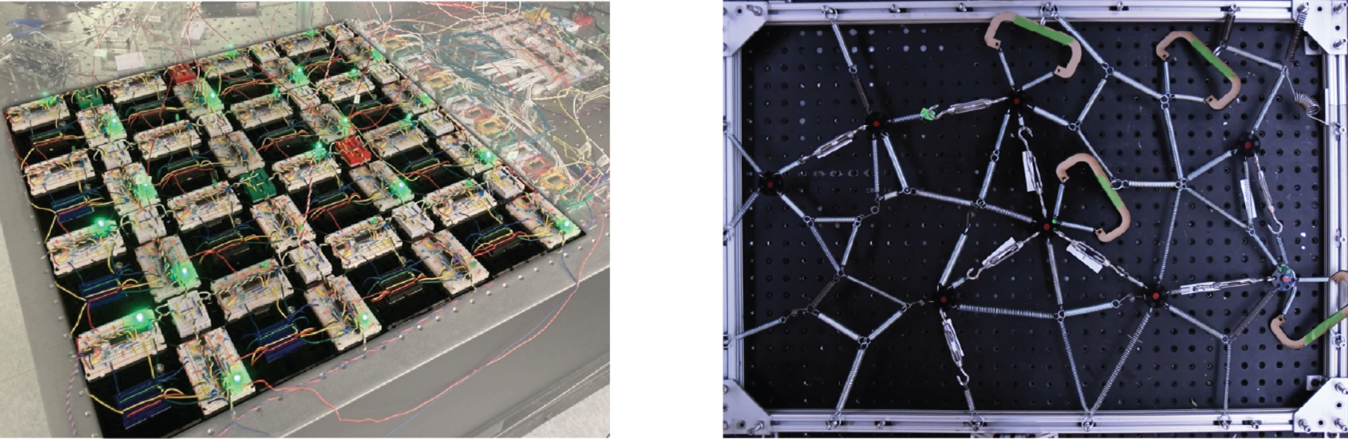
In his project, Nachi will investigate the basic principles behind how these physical learning systems work. What kinds of solutions do they find? How complex can the tasks be that they learn to perform? And how can we tell what a physical system has actually learned?
Even in the simplest electronic circuits Nachi has studied so far, answering these questions has already led to important insights. These findings could help develop new types of energy efficient hardware for artificial intelligence, something the modern IT industry urgently needs.
Future applications
The project will develop a theoretical framework for physical learning, starting with simple systems and gradually moving to more complex ones with richer learning abilities. The research could deepen our understanding of both artificial intelligence and biological systems. It could also help turn the idea of learning materials into practical technologies, from more efficient AI hardware to adaptive materials for robotics and medical applications.
Learn more
Would you like to learn more about Physical Learning, then read this news item about a paper published in the journal Physical Review Letters.
