A different way of computing
Modern computers separate memory and computation into different hardware components. As a result, enormous amounts of energy are spent continuously moving information between processors and memory units, a problem known as the ‘von Neumann bottleneck’.
The researchers wanted to explore a different approach: a material in which information storage and computation happen together. Although their demonstration is mechanical, the underlying design principles could eventually inspire similar approaches in, for instance, systems based on light-matter interactions.
Information stored in buckling beams
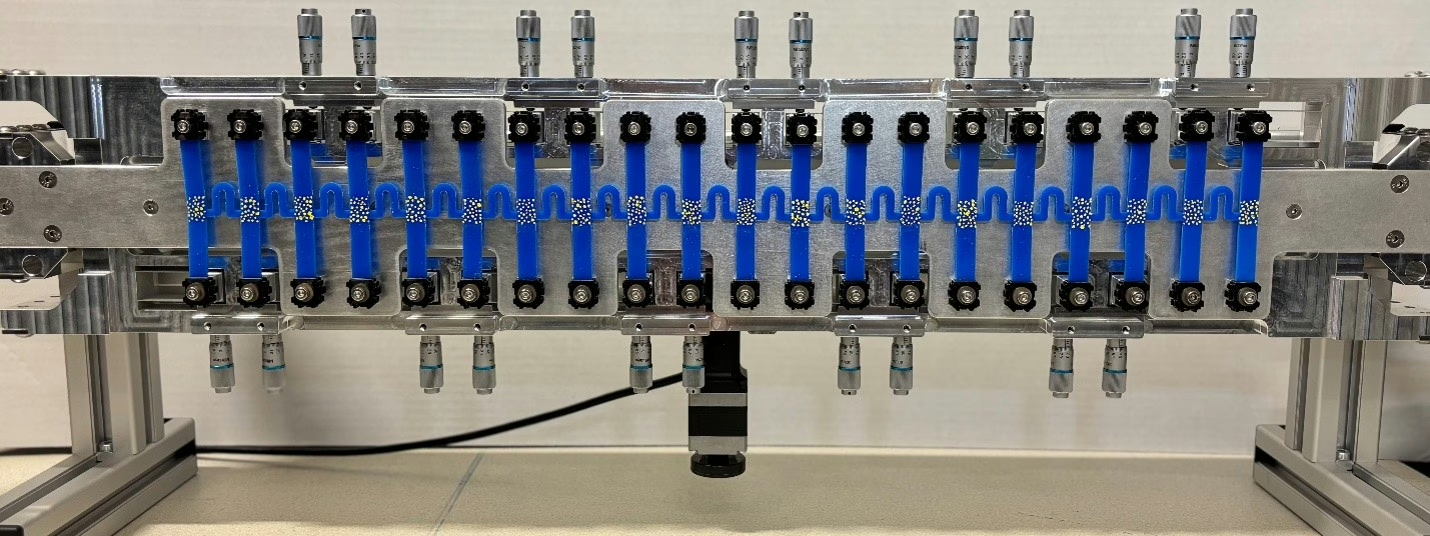
The researchers built an elastic metamaterial consisting of interconnected beams cut from a thin polymer sheet. Some of these beams can buckle into two stable positions, similar to a snap bracelet bending in opposite directions. These two states represent binary information: a ‘0’ or a ‘1’.
By periodically compressing the material, the researchers caused the stored ‘0’ and ‘1’ states to propagate through the structure. As the buckling pattern shifts step by step along the chain, information effectively travels through the material itself. The concept resembles racetrack memory, a proposed technology in which data moves through a magnetic device instead of remaining fixed in place.
The same structure performs logic operations
The key advance is that the same mechanical elements both store information and participate in computation. Using simulations, the researchers showed that their material could perform logical operations using structures that behave like NAND gates (short for NOT AND), which are fundamental building blocks of digital electronics. They also designed a mechanical half-adder, a simple circuit that adds binary numbers together.
Unlike many earlier mechanical computing systems, the material can continuously process streams of information without resetting after every operation.
Robust information transport
The motion of information through the material is guided by topology, a branch of physics that describes properties that remain stable despite small imperfections in the material. This makes the information transport robust against defects or fabrication imperfections.
Although the current system operates on relatively slow mechanical timescales, the researchers believe that miniaturized versions could one day lead to highly energy-efficient computing devices.
Learn more
- If you have questions about this research, then contact AMOLF group leader Marc Serra Garcia at M.SerraGarcia@amolf.nl
- The paper ‘Racetrack computing with a topological boundary ratchet’ was published in Physical Review Letters
- Read the full paper