People and recognition

Former AMOLF group leader Wim de Jeu passed away

Sadly, on June 3rd, 2026, former AMOLF group leader Wim de Jeu passed away. He will be remembered by many current and former AMOLF colleagues.

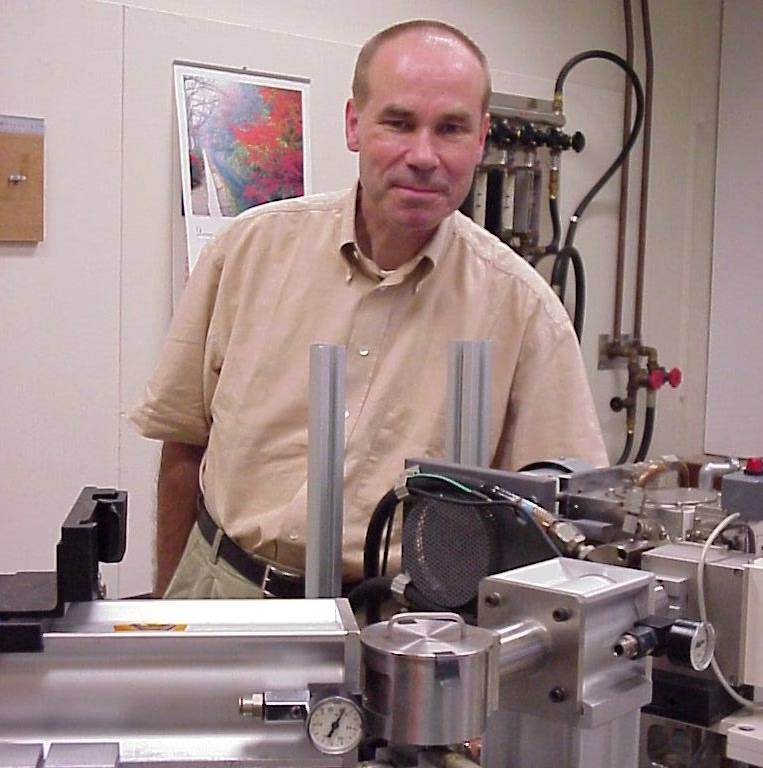
Wim de Jeu in front of the X-ray scattering equipment he developed.

From 1986 until his retirement in 2007, Wim headed the group Order/disorder in Soft Matter, which he combined with a position as professor, and later dean, at the Open University in Heerlen. Wim was an internationally recognized authority on liquid crystal physics – materials that combine the deformability of fluids with the optical properties of solids – and he was coauthor of a leading textbook in this field. His specific expertise was X-ray scattering, and at AMOLF he developed his own table-top wide-angle equipment.

Thanks in a large part to Wim, AMOLF became the Dutch contact person for the European Synchrotron Research Facility.  Wim also coordinated the building of the Dutch-Belgian Beam Line (DUBBLE) at the European Synchrotron Radiation Facility (ESRF), which was designed using the technical expertise of the mechanical and electronic support departments at AMOLF. Also, the AMOLF contribution to the software was substantial, covering beamline control, data analysis, and the firmware of the detector.

In 1999 Wim was awarded the Frederiks Medal by the Russian Liquid Crystal Society for his lifelong contributions to the field.

After his retirement in the Netherlands, Wim took up a professorship at Amherst (USA) but returned to the Netherlands after a few years to settle in Heerlen, keeping scientific contacts in Eindhoven and Julich (Germany). An important fruit of this period was the publication of his textbook Basic X-Ray Scattering for Soft Matter in 2016 which he considered a fitting final chapter to his scientific career. Wim leaves a legacy of more than 100 papers produced during his time at AMOLF and several generations of PhD students and postdocs that were trained in his lab.

Wim was a driven researcher and mentor. He will be remembered as an inspiring colleague: level-headed but with catchy sense of humour.
Share article
What's happening

Most recent news items

All news items
Joining forces to study perovskite interfaces
People and recognition

Joining forces to study perovskite interfaces

AMOLF group leaders Professor Wiebke Albrecht and Professor Bruno Ehrler have received an NWO ENW-M2 grant for their joint research project, The Dynamic Atomic Interface between Halide Perovskites and Metals. The insights gained will pave the way for sustainable, high-performance solar energy and information technology. Wiebke and Bruno will each hire a PhD student for this project. The grant amounts to €800.000.

Read news item
Wim Noorduin and Arian van Asten presenting their scientific journey
People and recognition

Wim Noorduin and Arian van Asten presenting their scientific journey

On October 8, Professor Wim Noorduin and his collaborator Professor Arian van Asten (University of Amsterdam) presented their scientific journey in a video to the audience at the ‘Avond van Wetenschap en Maatschappij’. They did so alongside the other nominees for the Huibregtsen Prize.

Read news item
Natural phenomena ‘hyperuniform disorder’ enables highly efficient, thin silicon solar cells
Research highlights

Natural phenomena ‘hyperuniform disorder’ enables highly efficient, thin silicon solar cells

Silicon solar panels are rigid and heavy, and many rooftops cannot support them. This creates a need for thin, flexible solar cells that can be integrated into building materials. However, making silicon solar cells thinner makes it harder to trap light inside the material. Researchers in the 3D Photovoltaics group found a fascinating way to overcome this challenge using a phenomenon called hyperuniform disorder. They publish their findings in the journal ACS Photonics.

The researchers were able to make highly efficient silicon solar cell materials that are 30 times thinner than conventional ones. They managed to do this by integrating a layer of nanometer sized structures on top of the material. Up close, this pattern looks random, but it is remarkably when you step back: no clumps, no gaps, and no repeating pattern. This is called hyperuniform disorder (or HUD).

Read news item
Stay informed

Get the latest research highlights, events, and news from our institute delivered to your inbox