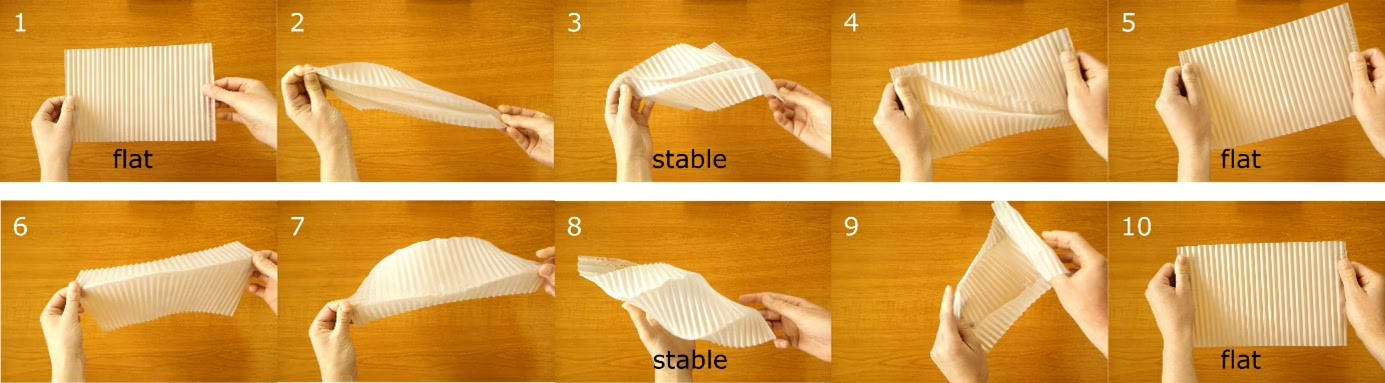
From a flower unfurling its petals to a robot grabbing an object: things are changing shape all around us. Over the years, researchers have been inspired by nature to create materials that can shift from one shape to another. But there is one problem. Usually, these shapes are not stable, and if they are stable they cannot be reshaped. Clay has a similar issue; a shape created with soft clay is not stable, but once the clay has been baked, its shape cannot be reset.
In their Nature publication, Meeussen and Van Hecke describe a new governing for the design of true ‘multistable’ metamaterials. “For the first time, we can make materials that can take on multiple stable conditions, which can also easily be reversed”, clarifies Van Hecke.
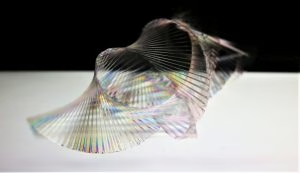
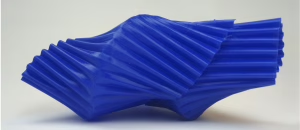
The basis of the discovery is a material with a deceptively simple structure: sheets of plastic – or any other flexible material – that contain corrugations, or grooves. When this groovy sheet is pulled, the grooves buckle and form an extended ridge perpendicular to the grooves. This ridge will stay in place – even if you stop pulling – and force the sheet into a new shape. Combining various ridges results in beautiful rolls, spirals and helical shapes, which are stable even when standing independently. “However, if you pull the sheet even further apart, the ridges disappear, and you can start reshaping again,” says Van Hecke.
Meeussen discovered that every buckled groove functions as a defect, and that neighboring defects ‘feel’ each other: if you bring them closer, they repel each other. “But, if two defects are exactly next to each other, they stick together.” This means that the ridges exist of chains of defects that attract and lock each other into place. “Understanding these defects, ridges and shapes took quite some time”, says Meeussen, who analyzed the material and carried out computer simulations, calculations and lots of experiments with corrugated plastic. “This all happened during COVID-19 lockdowns, so I did a lot of the experiments at home.”
The newly discovered principles of multistability and shapeshifting materials open up many different types of applications, such as foldable emergency housing; medical devices such as stents that can enter the body in one shape and once inside fold open into another stable, useful shape; and even robot parts that can easily switch back and forth between programable shapes are feasible.
All in all, a beautiful set of findings, especially since this research started out as literal child’s play. Van Hecke: “My daughter and a friend once played with a corrugated paper sheet they found in a cookie package. The friend pulled a ridge in the sheet and gave it to my daughter saying, “your dad will like this.” And she was right! After that my son also came up with various types of shapes and I knew that there was something exciting to be discovered.”
All three children were officially acknowledged for their contributions in the Nature paper.
Reference
A.S. Meeussen and M. van Hecke, Multistable sheets with rewritable patterns for switchable shape-morphing, Nature 621, 516–520 (2023).
DOI: 10.1038/s41586-023-06353-5.