Successful outcomes of international EBEAM program led by AMOLF
The EU Pathfinder project Electron Beams Enhancing Analytical Microscopy (EBEAM) that was recently completed has received a highly positive review of the European Innovation Council (EIC). EBEAM brought together eight European research institutions and companies, including AMOLF, that develop new concepts and instruments combining spectroscopic analysis with electron microscopy.
The EBEAM program that was co-initiated and directed by AMOLF group leader Professor Albert Polman, developed a range of new measurement techniques that significantly expand the capabilities of electron microscopy. Two product prototypes developed within EBEAM by the industrial partners are close to market introduction.
New generation of electron microscopy platforms
The review report, written by international experts, states: “EBEAM has laid the groundwork for a new generation of electron microscopy platforms, with applications spanning materials science, semiconductor metrology, renewable energy, and quantum technologies. EBEAM has not only achieved its objectives but has also set a standard for future initiatives in this field. It stands as an exemplar of how Horizon Europe and EIC funding can drive scientific excellence, economic growth, and long-term technological leadership”.
From innovation to application
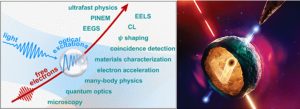
Several technologies developed within EBEAM are now moving towards practical use. A new module that measures light emitted by materials inside an electron microscope is being tested by early users. A prototype of an ultrafast electron microscope, which can capture extremely fast processes in materials, is being validated for use by researchers and industry. The program is also further developing software to reconstruct microscope images, while technology for generating ultrafast electron pulses has been licensed.
These developments show how EBEAM is helping to turn fundamental research into practical technologies. As the EIC panel wrote: “By supporting small and medium-sized companies and fostering collaboration, EBEAM is not just advancing technology, it’s driving economic growth and securing Europe’s position as a leader in this critical field.”
A closer look at the scientific milestones
In parallel to the technical developments, EBEAM has been very successful in developing new scientific insights. The outcomes have been published in more than 40 peer-reviewed journal articles. As written by the reviewers: “The achievements are remarkable: energy resolution has reached the sub-10 μeV range, temporal resolution has entered the attosecond regime, and the project has even demonstrated the world’s first quantum entanglement between free electrons and photons. These milestones are complemented by the development of novel techniques, such as self-referenced cathodoluminescence probing and Ramsey-type interferometry, which combine electron and optical fields in unprecedented ways.”
Partners
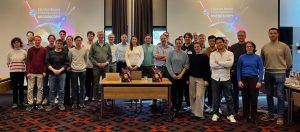
The EBEAM program was a collaboration between the Universities of Antwerpen, Göttingen, Kiel, and Paris Saclay, ICFO (Castelldefels, Spain), Delmic (Delft), Thermo Fisher (Eindhoven) and AMOLF. The final report of the EBEAM program and the list of publications are available at the EBEAM website: www.e-beam.eu.
Learn more
If you have any questions about the EBEAM program, please contact Albert Polman at email: a.polman@amolf.nl.
To read more about research in the Photonic Materials group led by Albert Polman, visit the www.amolf.nl.
