
Everything you need to know about organoids
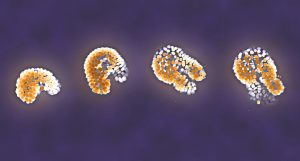
Organoids are instrumental in improving our understanding of processes that are otherwise hidden inside the body. For instance, these small 3D organs can be used to test medicines on tissue grown from a patient’s own cells. AMOLF researchers carry out unique and complex experiments to follow organoids in time. In order to enable other researchers to benefit from their experiences, they now publish their methods in the prestigious journal Nature Protocols.
Like a recipe in a cookbook
While most publications are about new discoveries, the recent publication in Nature Protocols focuses entirely on providing a detailed account of the research methods used, the challenges encountered, and how they were overcome. Group leader Professor Jeroen van Zon (Quantitative Developmental Biology) compares the publication to a recipe in a cookbook. He says, “A recipe needs to carefully describe each step and make sure that people can easily follow the instructions correctly. With our publication we do the same thing.”
Organoids at AMOLF
Organoid researchers at AMOLF carry out experiments typically not found elsewhere. They specialize in tracking single cells in organoids and following them over long periods of time. This teaches them how a single cell behaves in the context of the organ that it is part of. Together with group leader Professor Sander Tans (Biophysics), Van Zon recognized the value of sharing knowledge that normally stays in the lab, and they decided to put in the effort to document the tips, tricks, and troubleshooting.
One of the challenges the AMOLF researchers encounter is keeping the organoids healthy. Over time, they figured out how to preserve and handle them, how to position them effectively under the microscope, and how to make sure they are not damaged during microscopy imaging. All of this knowledge is now accessible to other organoid researchers.
Learn more
If you have any questions about this research, please contact group leaders Jeroen van Zon and Sander Tans.
The paper, titled “Quantitative imaging of dynamic processes in intestinal organoids,” was published in the journal Nature Protocols on September 15, 2026.
