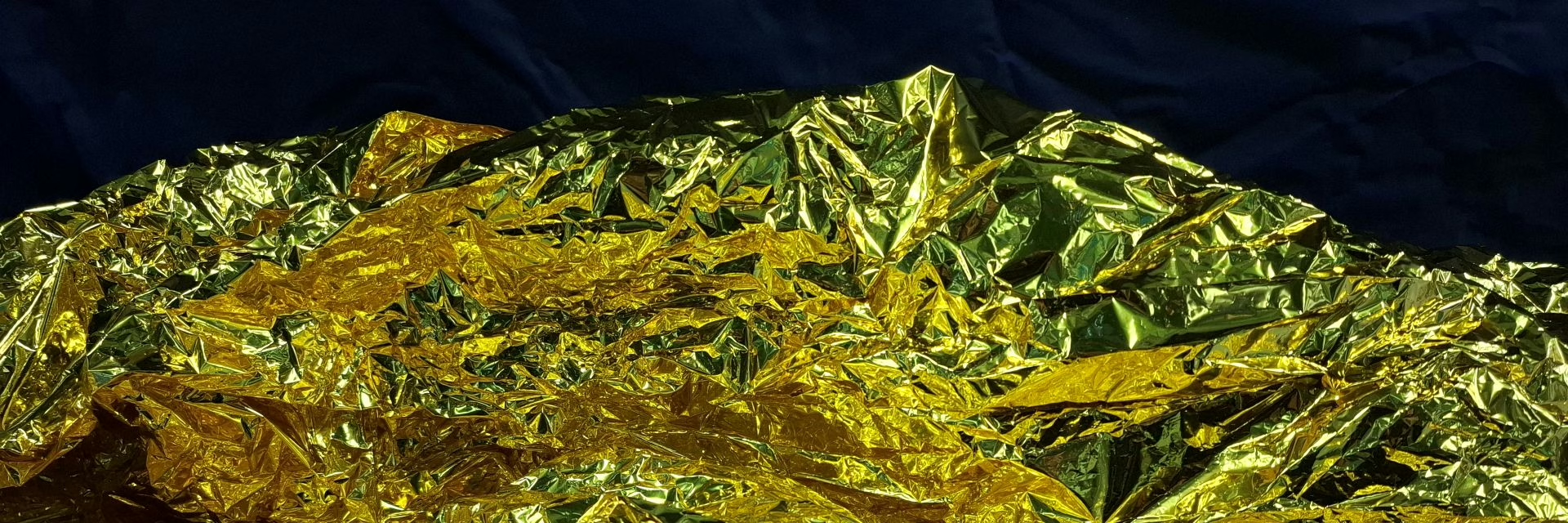
Unlike a rubber band that snaps back to its original shape after pulling, the shape of a crumpled sheet of paper remembers what you do to it – how you press it, how often, and even for how long. The history leaves traces in the disordered material. This is a form of memory: a crumpled object remembers what it has been through.
How does a material age?
Fascinated by the material properties, group leader Martin van Hecke (AMOLF/Leiden University) and collaborator Yoav Lahini (Tel Aviv University) decided to find out how materials age when they are repeatedly pressed and released. Consequently, their teams tested three vastly different disordered materials: crumpled plastic sheets, tangled bundles of steel wool, and wires made of an advanced metal alloy called Nitinol.
The research is somewhat reminiscent of how IKEA tests furniture by opening doors, loading chairs, or sliding drawers repeatedly until something breaks. But, instead of focusing on failure, the researchers wanted to know what happened before that. How does repeated use change a material over time?
Different looks, similar behavior
Writing in PNAS, the researchers report that all three materials show the exact same ageing behavior. As they were squeezed again and again, their internal friction slowly diminished, almost as if they slowly learned how to adapt to the repeated squeezing.
Co-first author Dor Shohat (currently AMOLF) says: “We were amazed to find that materials that look and feel so different actually behave in almost identical ways when you cycle them. By measuring the energy lost in each cycle, we discovered a signature of how these materials ‘relax’ and how they find more stable internal configurations over time.”
Significance of repetition
Co-first author Paul Baconnier (AMOLF/Leiden University) explains the significance of the repetition: “Normally, scientists look at how these materials age while they are sitting still. By shaking things up and driving them through thousands of cycles, we were able to reveal a much deeper level of organization that was previously hidden.” Another advantage of the cyclic approach is that the researchers found that while many existing theoretical models accurately describe material aging under constant stress, they fail as soon as the loading becomes cyclic.
What can we learn from this?
The scientific findings are useful for several reasons. First of all, they improve our understanding of how disordered materials age. This is critical for engineering more durable products: from ensuring that flexible electronics do not fail after repeated use to predicting how natural materials might weaken over time. Secondly, it helps explain why under repeated compression some models get ‘stuck’.
For example, large AI models behave somewhat like the tested crumpled materials. Their training resembles aging: step by step, the system changes through repeated stimuli. Sometimes these models get ‘stuck’ and stop learning further, and they seem to improve only by being made extremely large – resulting in enormous data centers. The new work suggests that alternative models may be possible, ones that more closely resemble how real materials continue to improve under repeated loading – and that might therefore be simpler and more efficient to train.
Learn more
- If you have questions about this research, please contact Martin van Hecke
- This paper was published in Proceedings of the National Academy of Sciences (PNAS), Aging of amorphous materials under cyclic strain
- Read the full paper