People and recognition

Cum laude for Federica Burla

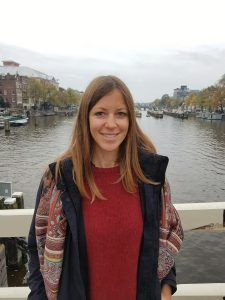
On Friday, June 19th Federica Burla defended her PhD thesis Tailoring Extracellular Matrix Mechanics online at the Vrije Universiteit in Amsterdam.
Burla obtained the cum  laude degree for her doctorate research. This degree is reserved for the top 5% of the students. Gijsje Koenderink was the promotor. Until recently, Burla was a PhD student in the AMOLF research group of Gijsje Koenderink who left AMOLF to become full professor at TU Delft.

During her PhD at AMOLF Burla wanted to understand how cells can create tissues with very different mechanical properties -such as skin, bones or bone marrow- by using a limited set of building blocks. To answer this question she created reconstituted tissues and measured their mechanical properties while looking at their structure. Together with collaborators from Wageningen, she modeled the behavior of these networks to quantitatively predict their properties. Burla: “We showed that a combination of architectural and molecular (plastic) effects determines the mechanical properties of a tissue, specifically its rupture point. We also discovered precisely how, by combining two different constituents of tissues, we can modulate the way tissues respond to deformation. These findings are interesting because they help us understanding the behavior of tissues in the body, especially in relation to diseases such as cancer or fibrosis, but we can also use these principles to create smart materials to replace damaged parts of the body.”

Burla’s research at AMOLF was part of the Industrial Partnership Program (IPP) with Unilever Research & Development: the Hybrid Soft Materials program.
 

Share article
What's happening

Most recent news items

All news items
Natural phenomena ‘hyperuniform disorder’ enables highly efficient, thin silicon solar cells
Research highlights

Natural phenomena ‘hyperuniform disorder’ enables highly efficient, thin silicon solar cells

Silicon solar panels are rigid and heavy, and many rooftops cannot support them. This creates a need for thin, flexible solar cells that can be integrated into building materials. However, making silicon solar cells thinner makes it harder to trap light inside the material. Researchers in the 3D Photovoltaics group found a fascinating way to overcome this challenge using a phenomenon called hyperuniform disorder. They publish their findings in the journal ACS Photonics.

The researchers were able to make highly efficient silicon solar cell materials that are 30 times thinner than conventional ones. They managed to do this by integrating a layer of nanometer sized structures on top of the material. Up close, this pattern looks random, but it is remarkably when you step back: no clumps, no gaps, and no repeating pattern. This is called hyperuniform disorder (or HUD).

Read news item
Off Road grant for a better understanding of intestinal cells that communicate with the immune system
People and recognition

Off Road grant for a better understanding of intestinal cells that communicate with the immune system

AMOLF postdoc Dr. Susanna Eli received an Off Road grant from ZonMw to investigate cells known as M cells in the gut lining that connect the intestine to the immune system. Understanding how M cells develop could ultimately contribute to better treatments for intestinal and immune-related diseases. The grant amounts to 100,000 euros.

Read news item
Science for all ages at Wetenschapsdag 2026
Events and outreach

Science for all ages at Wetenschapsdag 2026

Each year during the national Weekend of Science, AMOLF opens its doors to visitors of all ages to share our enthusiasm for science. AMOLF organizes Wetenschapsdag together with four other research organizations at Amsterdam Science Park: ARCNL, Nikhef, CWI, and University of Amsterdam.

Read news item
About AMOLF

Annual AMOLF Diversity Day focuses on Impostor Phenomenon

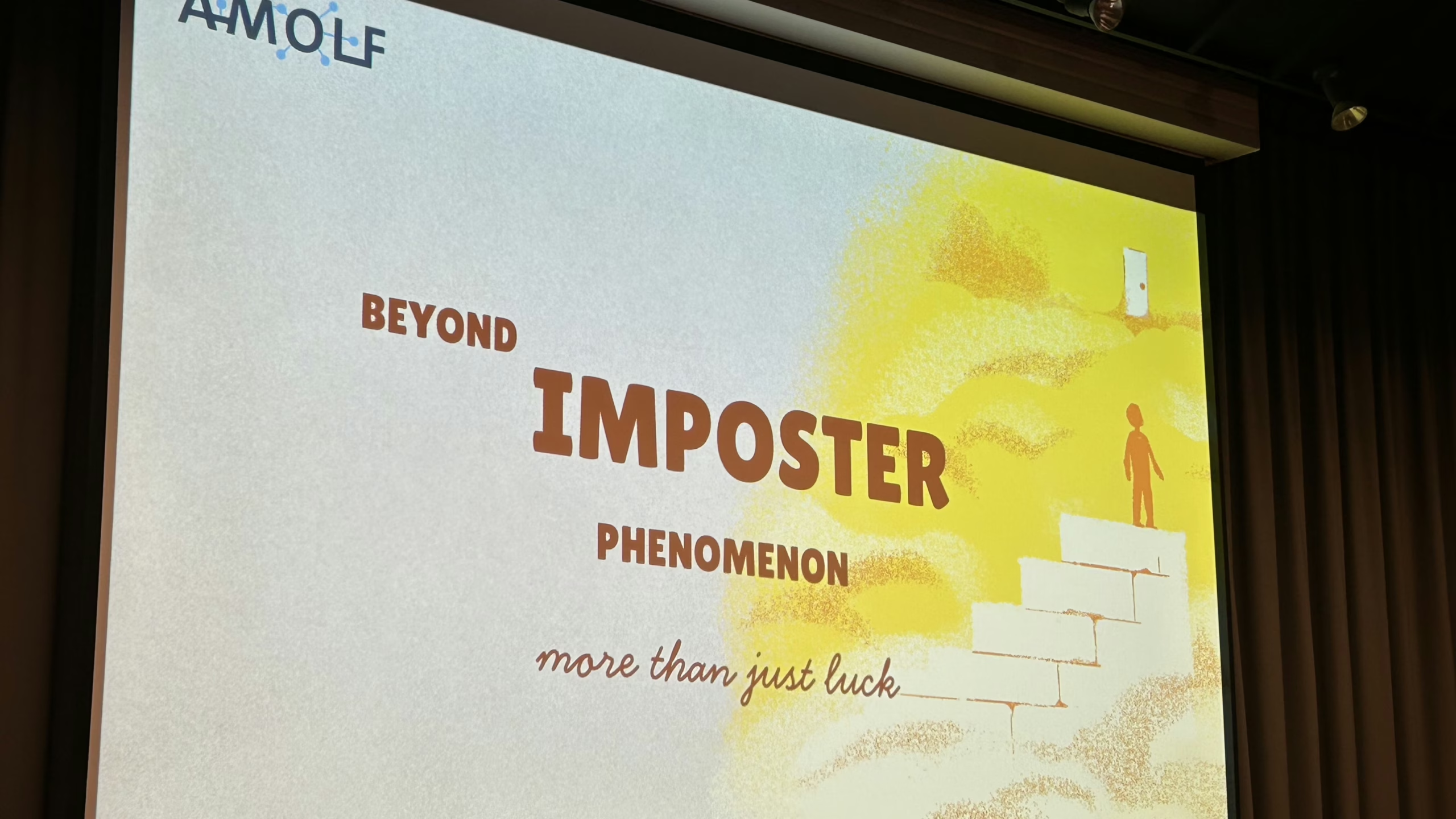
Once a year, the AMOLF Inclusion and Diversity team organizes Diversity Day for all AMOLF employees. On October 1, this year’s event took place with the theme Beyond Impostor Phenomenon – More Than Just Luck.

Read news item
Stay informed

Get the latest research highlights, events, and news from our institute delivered to your inbox