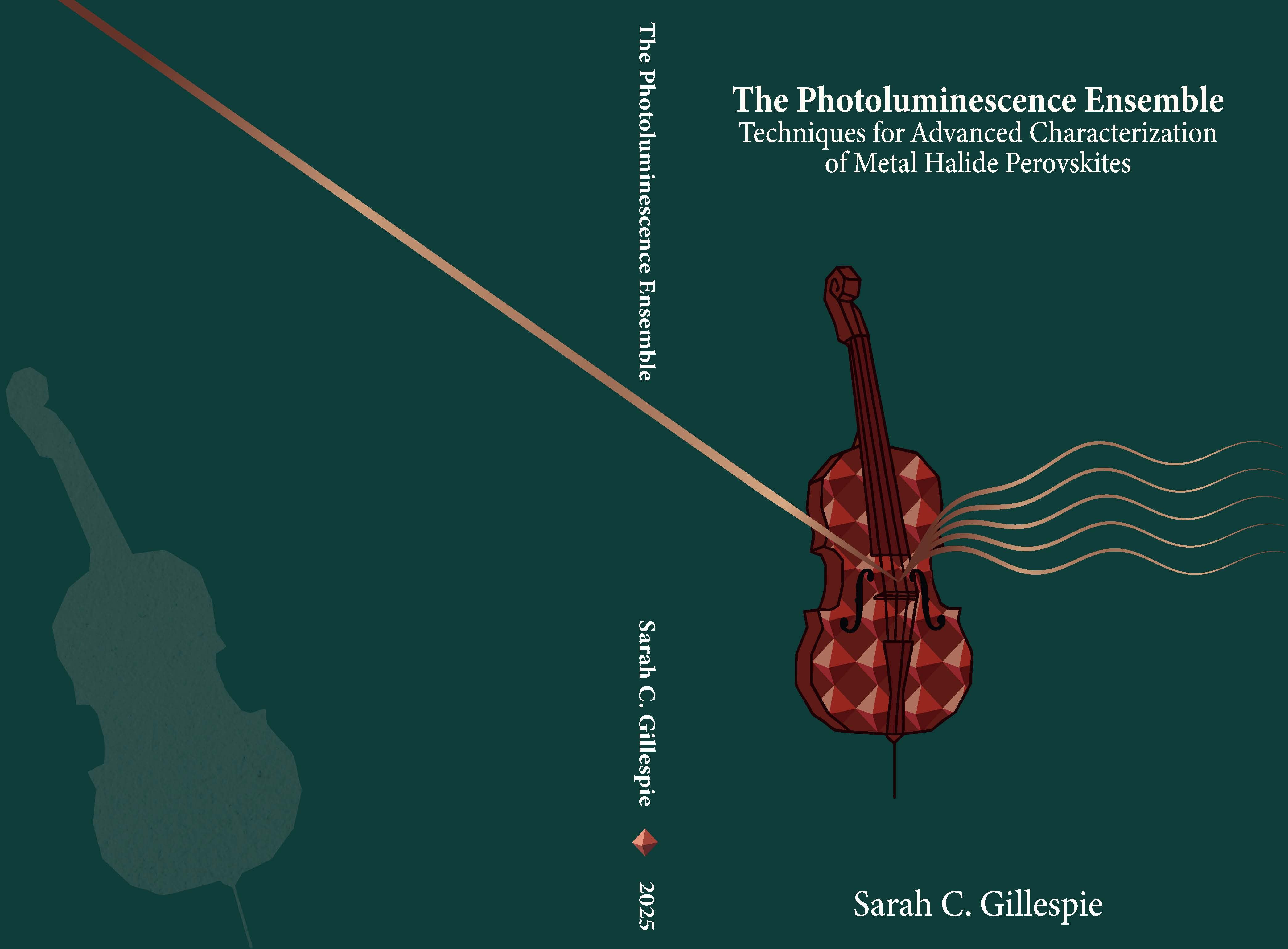

The Photoluminescence Ensemble: Techniques for Advanced Characterization of Metal Halide Perovskites
Meeting global energy demands in the coming decades – without sacrificing the planet’s natural environment – requires a complete transition to energy sources that are affordable, abundant, and entirely clean. Solar energy is a particularly valuable and inexhaustible resource. Achieving a successful clean energy transition, however, demands photovoltaic (PV) technologies with efficiencies beyond those attainable by silicon alone. To address this, metal halide perovskites have emerged as a transformative class of semiconductors for PV applications – yet their unconventional electronic-ionic properties pose new challenges for commercialization. Maximizing the potential of perovskite PV therefore requires a detailed, fundamental understanding of these materials.
This thesis advances that understanding by extracting the maximal information from photoluminescence (PL) – an intrinsic material property shaped by both electronic and ionic interactions. This thesis demonstrates how recombination losses can be quantified and resolved using time-resolved PL spectroscopy coupled with PL quantum yield analysis. It further shows how PL time-series analysis can be applied as a reliable technique to improve device performance and stability, particularly under dynamic illumination protocols. Notably, this work introduces a novel, contact-free, frequency-domain PL technique: intensity-modulated photoluminescence spectroscopy (IMPLS). IMPLS provides detailed insights into ionic properties such as characteristic time constants, diffusion coefficients, and spatial distributions of mobile ions, while also enabling identification of the dominant mobile species in halide films.
Together, these advances expand the capabilities of PL-based characterization, enabling deeper insights into perovskite semiconductors and driving progress to optimized perovskite PV technologies.