
Mechanical Adaptability in Fluidic Soft Robots
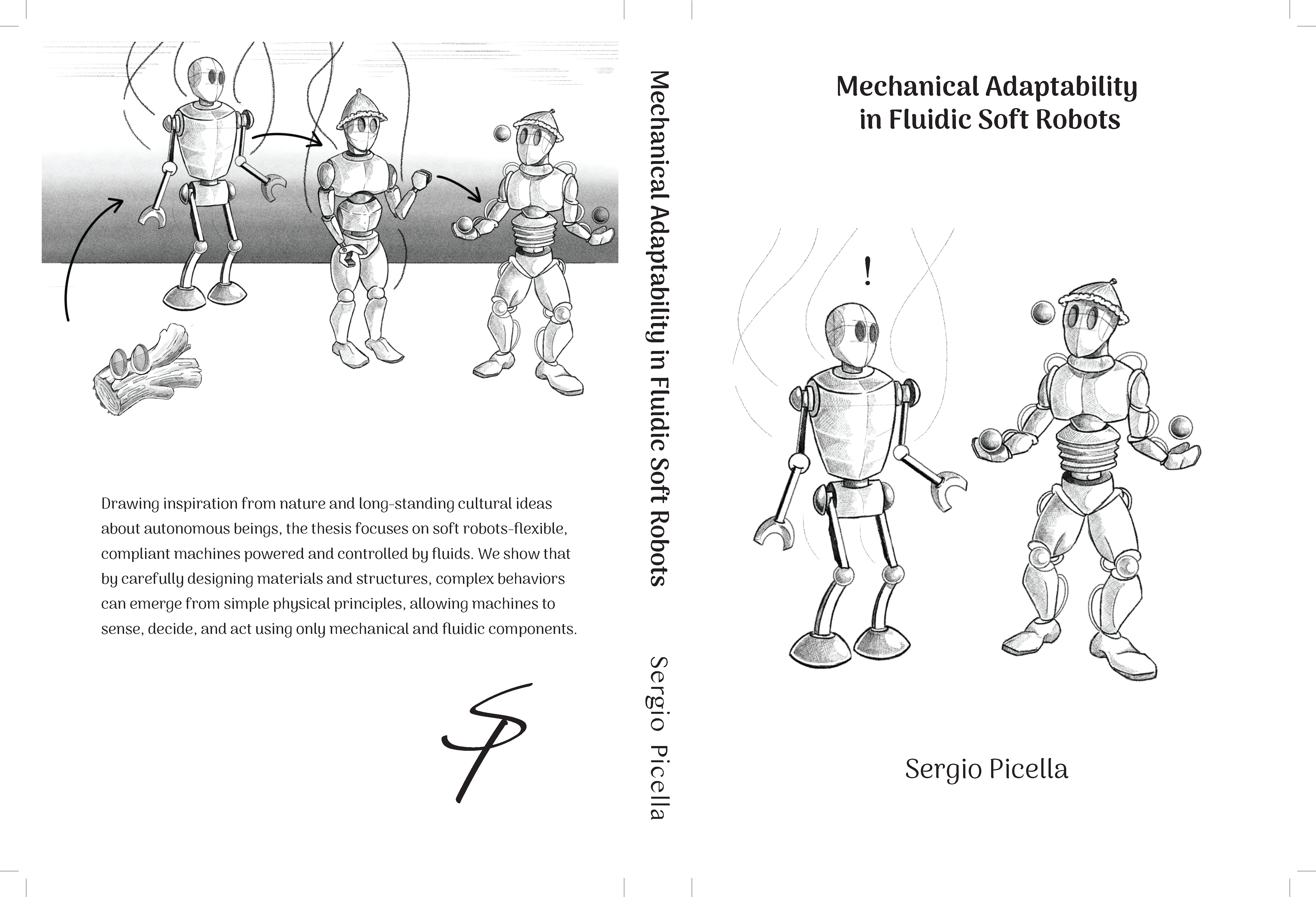
The ability to integrate control, actuation, and sensing into devices has trans- formed how human tasks are automated and simplified. Necessities and efficiency requirements have reshaped how resources are used, to the point that entire eras have been named after the materials we manipulate, from Stone Age to today’s Anthropocene and Plastic Age. To support this transformation, increasingly advanced tools have been created, evolving from simple hardware to systems capable of programmed responses to external stimuli. As these systems achieve greater complexity, so too have expectations grown for their capacity to operate independently of human input. Long before the word robot was even coined (1920), literature explored the idea of creating human-like substitutes through characters like Frankenstein (1818) or Pinocchio (1883), challenging readers with the technological, philosophical, and ethical dilemmas of granting them autonomy. These narratives anticipated many of the debates we now face in the development of artificial intelligence and autonomous systems, leading to a central question: how can autonomy be designed into synthetic agents, and is it even possible? This thesis examines design strategies for fluidically powered devices capable of functioning without human oversight, with particular focus on the challenges of achieving mechanical adaptability in soft robotic systems. To translate physical structure into behavior and reproduce levels of autonomy manifested throughout the Eukaryota, we explore soft robotics’ compliant hardware as a platform for mechanical adaptability, demonstrating that complex behaviors can be encoded in hardware alone, using fluidics only. To materialize our approach, we use mechanical and fluidic non-linearities, such as buckling instabilities and phase transitions, that can express complex responses to simple external stimuli.