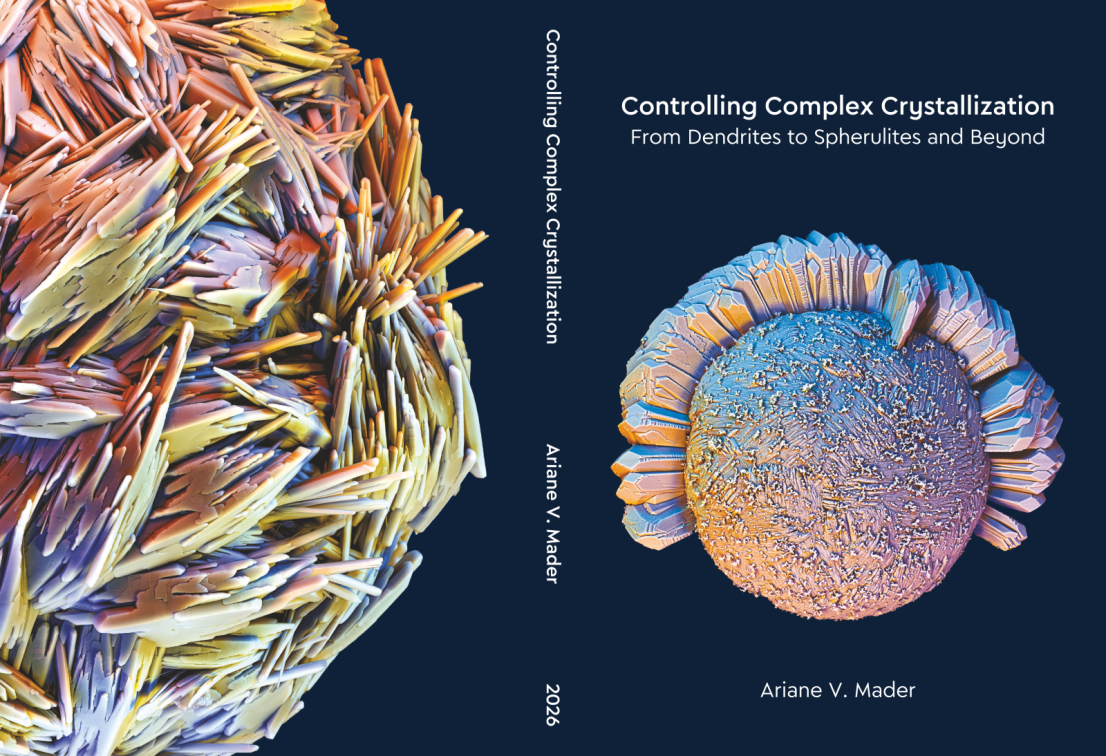

Controlling Complex Crystallization: From Dendrites to Spherulites and Beyond
This thesis investigates how complex crystal morphologies can emerge
from simple inorganic systems under mild, aqueous conditions. It
demonstrates that structural complexity does not require biological
templates or extreme environments, but can arise from the interplay of
kinetics, diffusion, additive interactions, and sequential growth.
Using carbonate- and sulfate-based systems, several strategies to
control crystal morphology are developed. Small organic additives are
shown to direct growth by selectively inhibiting specific crystal faces,
enabling hierarchical multilayered structures. Silica enables the
formation of compact, shape-controlled spherulites with tunable size,
and allows growth to be paused and resumed, facilitating sequential
shaping into non-classical geometries. In another system, silica can
induce growth reorientation and morphological transitions, generating
complex structures even outside classical biomorph-forming conditions.
Additionally, self-assembled nanocrystals are introduced as nucleation
directors, allowing precise spatial and crystallographic control over
sequential crystal growth. This approach enables the construction of
complex, hierarchical architectures and their transformation into
single-material systems through ion-exchange processes.
Across these systems, the results show that morphological complexity
emerges from fundamental physical and chemical principles, including
crystallographic anisotropy, diffusion-limited growth, and kinetic
inhibition. The findings highlight new routes toward the rational design
of inorganic materials with tailored architectures. More broadly, this
work contributes to bridging crystal growth science with materials
engineering, while pointing toward the need for predictive frameworks to
better understand and control additive-directed crystallization.