
Microscopic metamaterials that can shrink and expand on their own
Physicists from AMOLF and Leiden University created the first micro-scale metamaterials that can take on specific shapes without external control. This breakthrough paves the way for smart, self-adapting materials. The research team presented the groundbreaking research into micro-scale metamaterials in Nature on February 25.

Metamaterials are materials that derive their mechanical properties from their geometry, rather than the material they are made of. Group leader Martin van Hecke (AMOLF/Leiden University) has a long track record in metamaterials research. His team designed metamaterials that shrink and expand in all directions or can morph their shapes.
Microscale
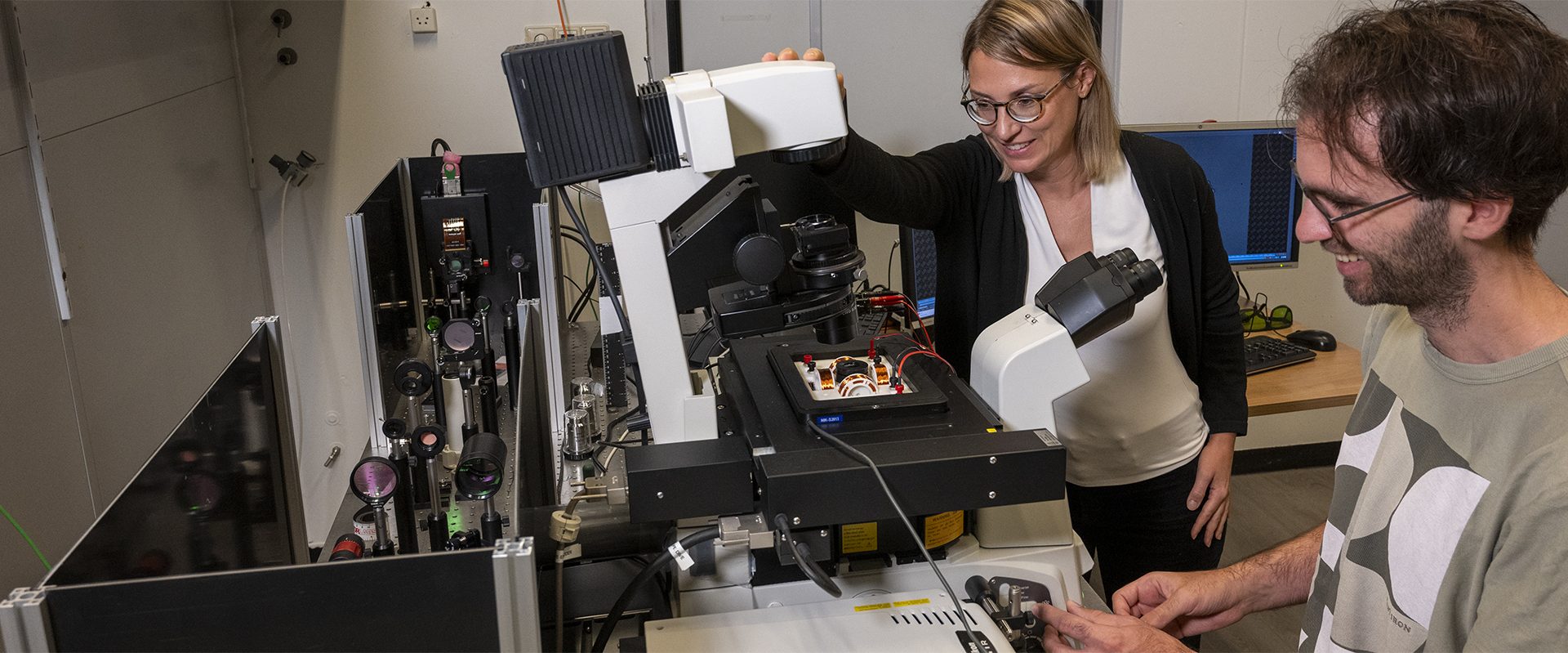
While metamaterials were traditionally made at the macroscale, the team led by Daniela Kraft (Leiden University) translated this principle to the microscale, which is useful for building microrobots and studying biological principles. In the lab at Leiden University, they created hierarchical structures of microparticles that can deform in the same way as macroscopic metamaterials and can do so independently by using thermal energy. This is possible thanks to their exceptional softness and structure.
Connecting with DNA molecules
The key to these special properties lies in their design: mechanical metamaterials are often constructed from triangular or quadrangular rigid elements. These must then be connected to each other at the corners in exactly the right way, and in such a way that they can still rotate relative to each other. To achieve this, a small ball was placed at each corner of these elements and bonded to the neighboring particles. The bond was created by DNA molecules that can move across the particle surface. This creates a structure in which two adjacent elements can rotate around jointly bonded particles, known as a hinge point.

The combination of rigid elements and hinge points was essential to the construction of these metamaterials. The researchers showed that a structure made up of diamonds can only deform in one specific way: all movements of the particles are correlated. And because the structures are very small and the hinges are very mobile, the structures created are also very soft. The structures are sufficiently soft to be deformed by thermal energy alone. Biological structures also use such thermal fluctuations for their movements and functions. The synthetic variants now presented use this energy to shrink and expand in a controlled manner in all directions, known as auxetic behavior.
The researchers then built a structure out of triangles that can deform in several ways, including one auxetic way that ‘folds’ the structure, as it were. To selectively control this auxetic deformation, the researchers used magnetic spheres in their metamaterials. By cleverly placing these in the structures and using a magnetic field, the structure always folds itself into the same final shape.
Application in innovations
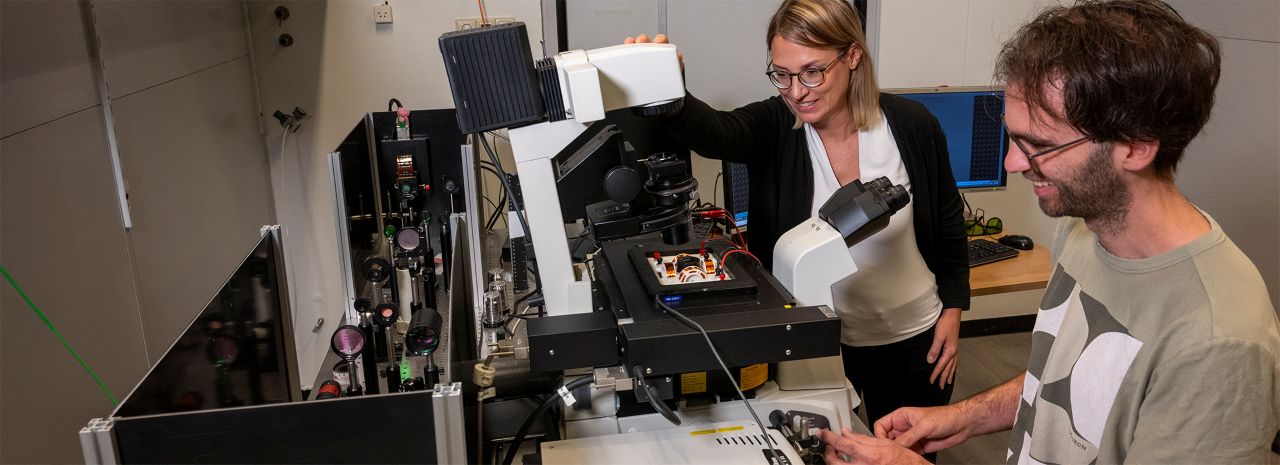
Now that the Leiden physicists have demonstrated that a metamaterial can be created and controlled on a micro scale, all kinds of follow-up research is conceivable. Martin is enthusiastic about this new microscale approach and says: “Using this method, we can engineer intelligent materials that respond automatically to changes in their surroundings. We plan to further advance and refine this technology in the near future.”
Learn more
- If you have questions about this research, please contact Martin van Hecke at v.hecke@amolf.nl.
- This paper, “Pivoting colloidal assemblies exhibit mechanical metamaterial behavior”, was published in Nature.
- Read the full paper
