People and recognition

AMOLF group leader Wim Noorduin wins prestigious NWO Stairway to Impact Award

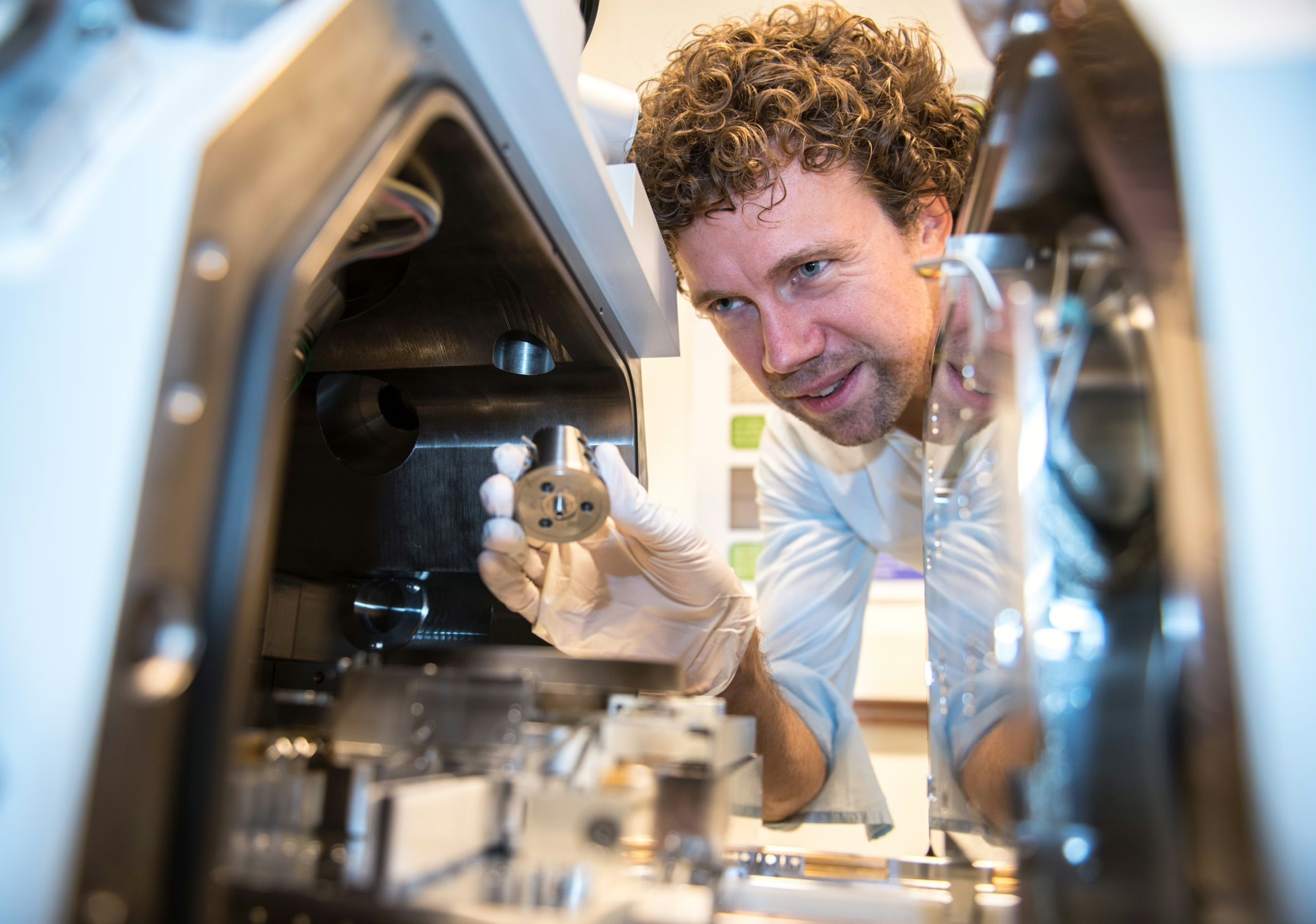
Wim Noorduin (AMOLF group leader / UvA professor) has been awarded the prestigious NWO Stairway to Impact Award for his success in translating fundamental research into a societal application. In close collaboration with his group members Wim developed a lead detection test and started the company Lumetallix to address global lead poisoning.

Wim Noorduin

Stairway to Impact Award

The Stairway to Impact prize honors scientists who successfully translate their research findings into solutions that address societal challenges or generate economic benefits. The award includes a €50,000 grant to further these impactful efforts. Wim will receive the prize at the upcoming NWO Physics conference in Veldhoven.

Jury Report

The jury commended Wim on his remarkable achievements. In their report, they stated:
“The committee is highly impressed by Professor Noorduin’s efforts to actively seek diverse applications for the lead test, thereby pursuing various avenues of societal impact. Not only does Professor Noorduin demonstrate its clear potential in the fields of health and environment, but he is also exploring applications in forensics. The committee applauds his collaboration with the police.”
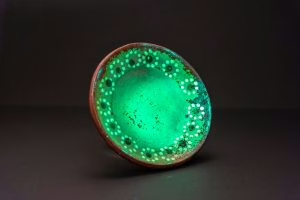
Lead containing plate lighting up after sprayed with test kit.

The discovery

While working from home during the COVID pandemic, Wim discovered a chemical method to detect the presence of lead atoms on a surface. His group was studying a very promising material for solar cells, called perovskite, when he realized that the light-emitting properties of this material could help visualize lead atoms. This discovery appeared to offer a promising solution to the global problem of lead poisoning. After all, people are often unaware of lead in their environment.

To test the idea, PhD student Lukas Helmbrecht prepared a solution capable of forming a perovskite upon contact with lead. Wim sprayed the solution on a gutter at home. The surface immediately emitted a bright green luminescence. To their surprise, the same reaction occurred on the paint of an adjacent window frame, indicating that both surfaces contained lead. The green light revealed the formation of a lead perovskite semiconductor, confirming the presence of lead.
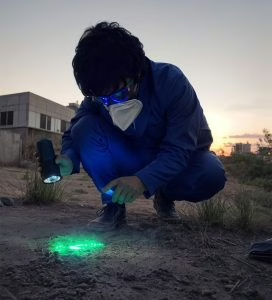
Pure Earth / TAUW (India)

Impact

Recognizing the potential impact of his discovery, Wim, alongside group members such as Lukas, embarked on a journey that ultimately led to the creation of a start-up company, Lumetallix. In partnership with Pure Earth, Lumetallix now distributes test kits to countries where they are most needed, addressing a critical public health issue.

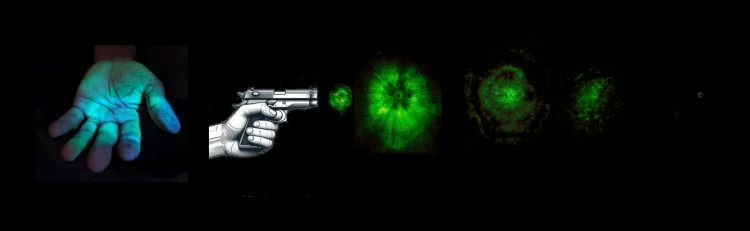
A new application for the lead detection method emerged recently. Collaborating with Kendra Adelberg, Arno van der Weijden, and Professor Arian van Asten from the University of Amsterdam, Wim is investigating its use in forensic science. When a pistol is fired, traces of lead are left in the surrounding environment. Because the lead detection method is fast and accurate, it promises to become a valuable forensic tool. This potential for forensic investigations is now further explored with forensic experts and police.
More information about the Stairway to Impact prize, and a video interview with Wim on the NWO website.


Photo credits: Lukas Helmbrecht, Arno van der Weijden Kendra Adelberg, and Lumetallix
Share article
What's happening

Most recent news items

All news items
Joining forces to study perovskite interfaces
People and recognition

Joining forces to study perovskite interfaces

AMOLF group leaders Professor Wiebke Albrecht and Professor Bruno Ehrler have received an NWO ENW-M2 grant for their joint research project, The Dynamic Atomic Interface between Halide Perovskites and Metals. The insights gained will pave the way for sustainable, high-performance solar energy and information technology. Wiebke and Bruno will each hire a PhD student for this project. The grant amounts to €800.000.

Read news item
Wim Noorduin and Arian van Asten presenting their scientific journey
People and recognition

Wim Noorduin and Arian van Asten presenting their scientific journey

On October 8, Professor Wim Noorduin and his collaborator Professor Arian van Asten (University of Amsterdam) presented their scientific journey in a video to the audience at the ‘Avond van Wetenschap en Maatschappij’. They did so alongside the other nominees for the Huibregtsen Prize.

Read news item
Natural phenomena ‘hyperuniform disorder’ enables highly efficient, thin silicon solar cells
Research highlights

Natural phenomena ‘hyperuniform disorder’ enables highly efficient, thin silicon solar cells

Silicon solar panels are rigid and heavy, and many rooftops cannot support them. This creates a need for thin, flexible solar cells that can be integrated into building materials. However, making silicon solar cells thinner makes it harder to trap light inside the material. Researchers in the 3D Photovoltaics group found a fascinating way to overcome this challenge using a phenomenon called hyperuniform disorder. They publish their findings in the journal ACS Photonics.

The researchers were able to make highly efficient silicon solar cell materials that are 30 times thinner than conventional ones. They managed to do this by integrating a layer of nanometer sized structures on top of the material. Up close, this pattern looks random, but it is remarkably when you step back: no clumps, no gaps, and no repeating pattern. This is called hyperuniform disorder (or HUD).

Read news item
Off Road grant for a better understanding of intestinal cells that communicate with the immune system
People and recognition

Off Road grant for a better understanding of intestinal cells that communicate with the immune system

AMOLF postdoc Dr. Susanna Eli received an Off Road grant from ZonMw to investigate cells known as M cells in the gut lining that connect the intestine to the immune system. Understanding how M cells develop could ultimately contribute to better treatments for intestinal and immune-related diseases. The grant amounts to 100,000 euros.

Read news item
Stay informed

Get the latest research highlights, events, and news from our institute delivered to your inbox