A remarkable run of PhD ceremonies
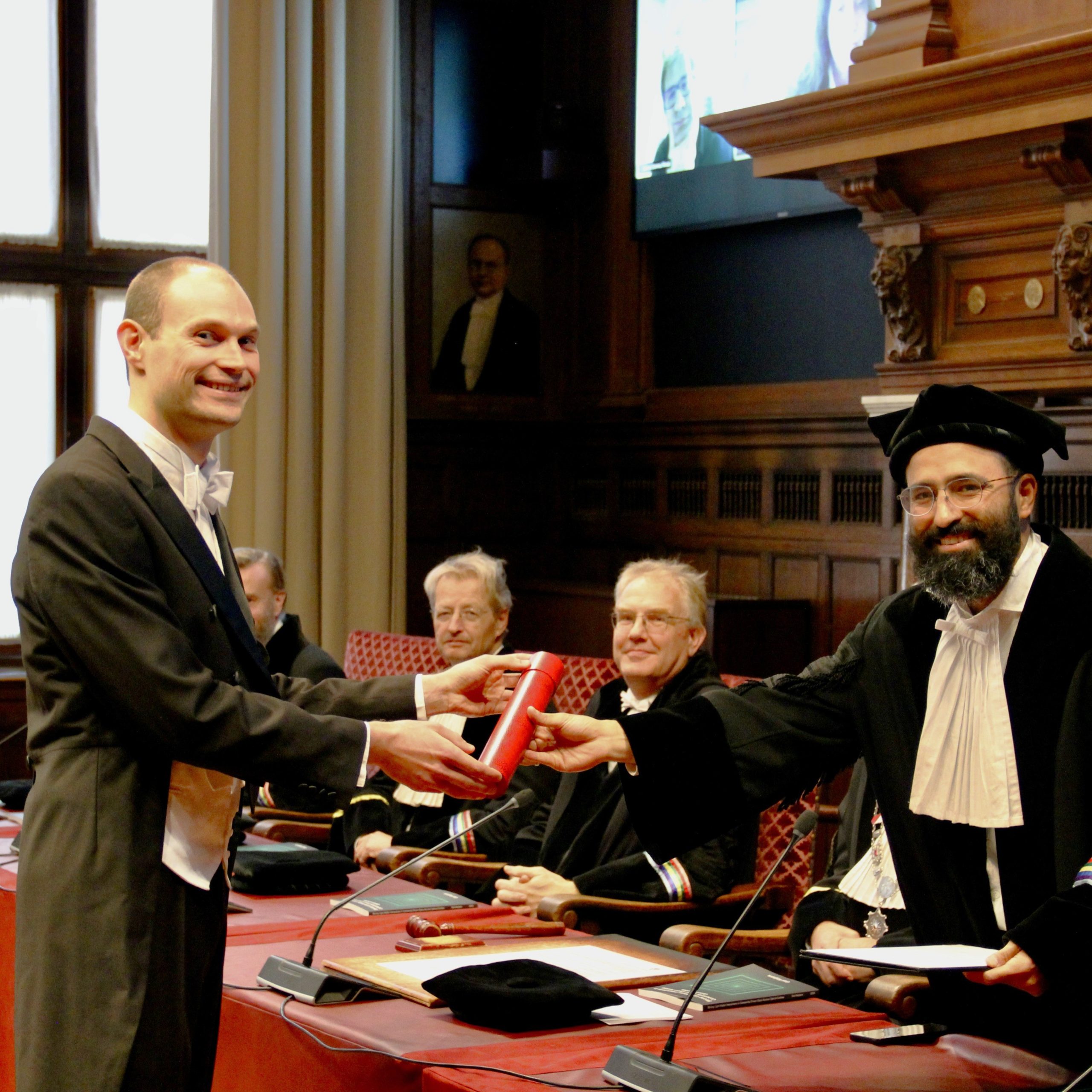
Giel Keijsers
- Title: Strong light-matter interactions in coherently driven open-access optical cavities
- Date: November 4
How can you influence the behavior of light using light itself? In his thesis Giel Keijsers describes how he managed to achieve exactly that. It was no easy challenge, since light normally does not interact with light.
Giel explains: “We had to help the light, and we did so using an optical cavity consisting of two mirrors facing each other. Inside this cavity, light bounces back and forth. To facilitate the interaction, we placed a special material between the mirrors.”
The most important finding of Giel’s doctoral research is that he succeeded in steering the behavior of light so that it emulates superfluidity: a phase of matter similar to a fluid but with fascinating additional features, like flow without friction.
Learn more
- To read more about Giel’s research, read this news item about new properties discovered in promising optical materials.
- View Giel’s thesis in the AMOLF repository
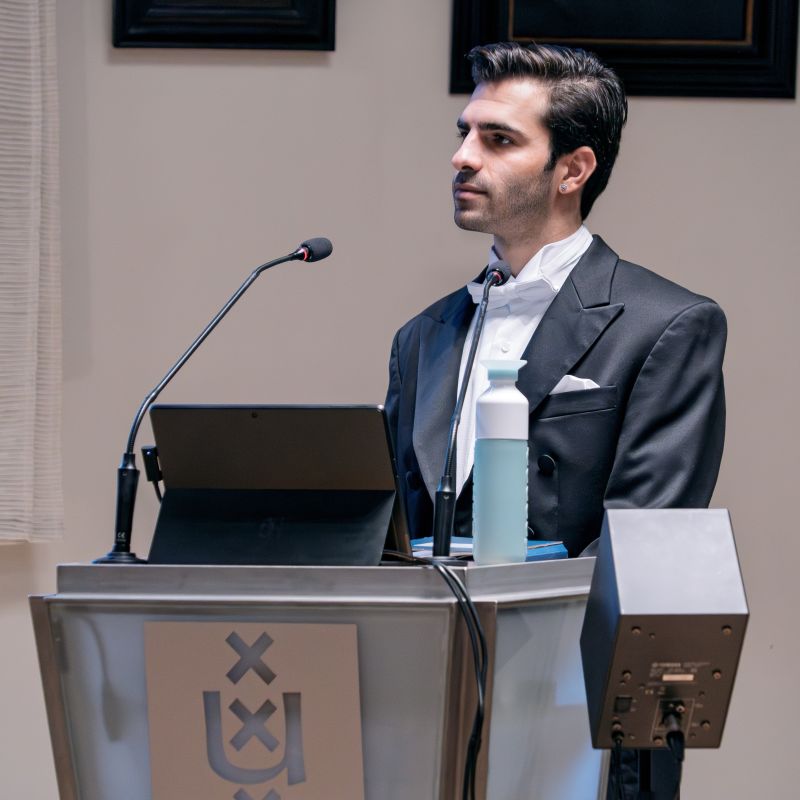
Maziar Arfaee
- Title: Can soft robots donate their heart to humans? Emerging technologies in total artificial heart development
- Date: December 8
During his time at AMOLF Maziar Arfaee worked on building two Hybrid Hearts.
Maziar’s first artificial heart was a soft robotic total artificial heart powered by a so-called TET system for energy transfer and coated with tissue engineering inner lining. The second one, called LIMO, was a fully artificial heart that demonstrated an efficient fluidic transmission system allowing for a more compact heart. Maziar explains: “The main difference between the two is different ways of pumping blood with soft robotic actuation.”
Learn more
- Read about the hybrid hearts Maziar developed: Breakthrough in heart technology and Promising Hybrid Heart prototype
- View Maziar’s thesis in the AMOLF repository
Sarah Gillespie
- Title: The photoluminescence ensemble: techniques for advanced characterization of metal halide perovskites
- Date: December 11
- Honors: cum laude
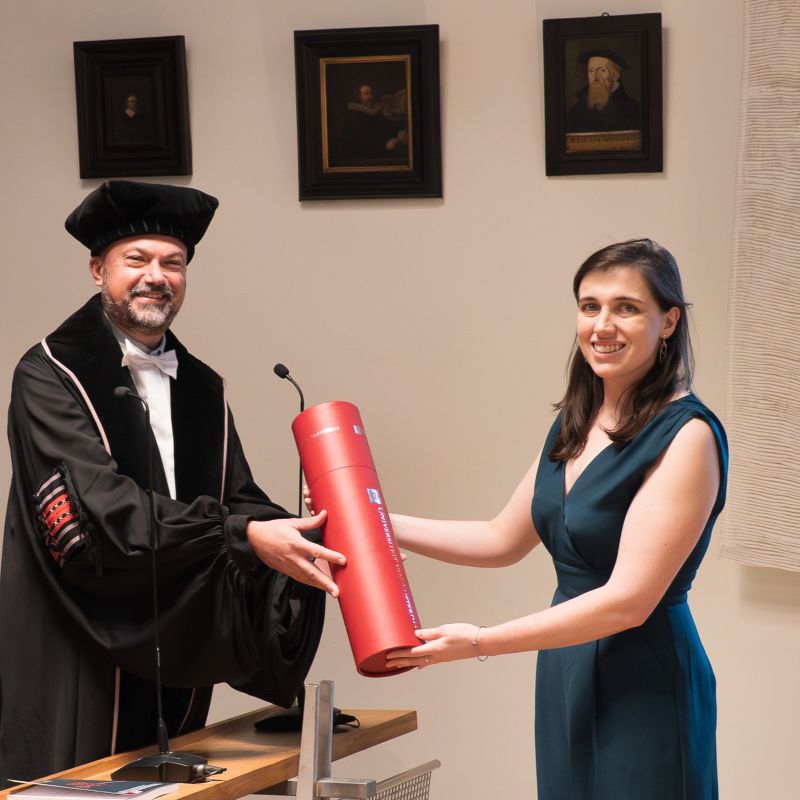
During her PhD, Sarah developed a special technique to manipulate halide perovskites: a promising material for solar energy. Perovskites pose various challenges, particularly surrounding their instability. Sarah explains: “To use these perovskites, we need to understand what causes their instability. A great way to do so is to use light. We shine light on the material with varying light intensity at a set frequency. At the same time, we track the emission – the photoluminescence – from the sample. We go through all the different frequencies until we find one that resonates. If you hit the right frequency, the perovskite will ‘sing’. This teaches us a lot about the ion migration that causes their instability.”
Learn more
- Read more about the technique Sarah and her colleagues developed
- View Sarah’s thesis in the AMOLF repository
Nick Feldman
- Title: Optical metasurfaces for information efficient nanoscale metrology
- Date: December 17
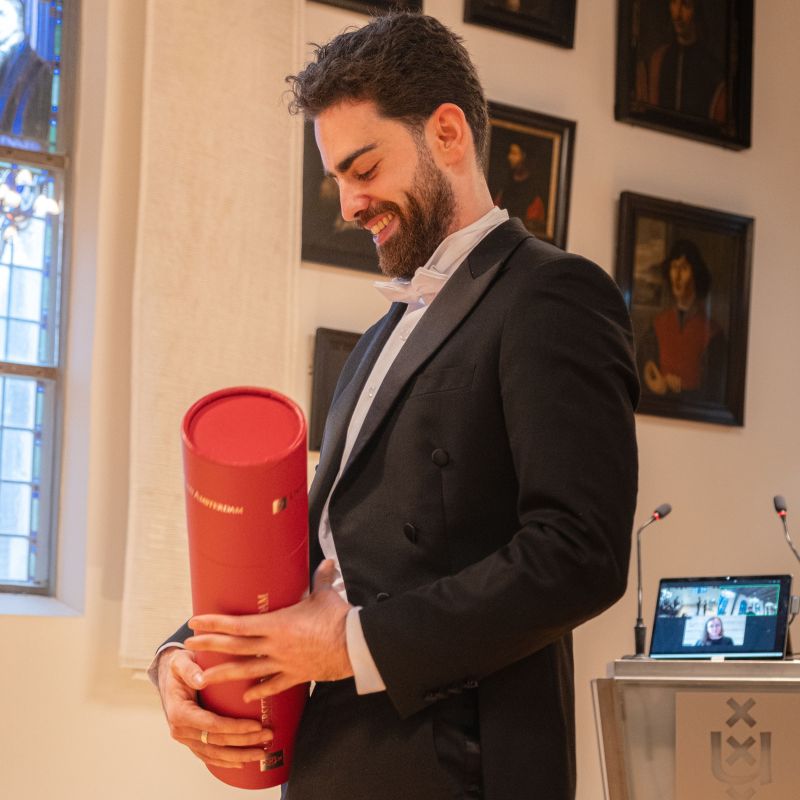
Modern computer chips rely on intricate networks fabricated with sub-nanometer precision. As devices become smaller and more powerful, accurate process control is essential. With his thesis Nick develops nanophotonic strategies for information-efficient optical metrology at the nanoscale. It investigates metasurfaces, artificial surfaces made of nanoscale structures, as advanced sensors and explains how they convert tiny details into measurable light signals detected at a distance. Nick’s work also shows how shaping the incoming light, together with smart metasurface design, improves measurement accuracy and reliability.
Learn more
- To find out more about Nick’s latest publication in Nature Communications
- View Nick’s thesis in the AMOLF repository.
Falco Bijloo
- Title: Dynamic nonlinear light control and metrology with resonant metasurfaces
- Date: December 17
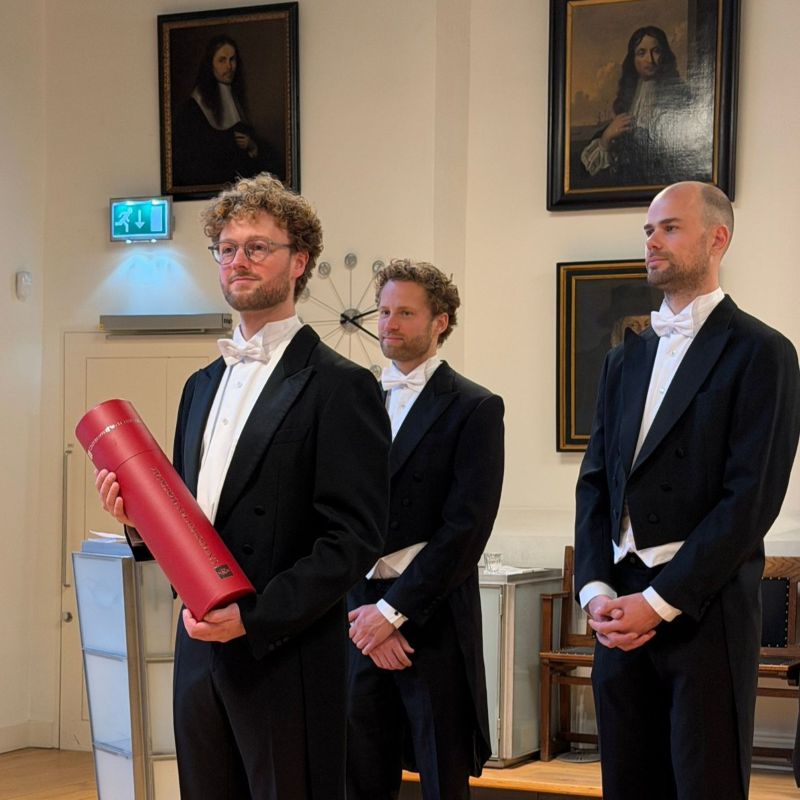
As computer chip features shrink, nanoscale inspection becomes increasingly challenging for conventional optics. Falco’s thesis explores nonlinear optical metrology using resonant metasurfaces: arrays of nanostructures that strongly manipulate light. By exploiting enhanced harmonic generation (light emitted at multiples of the original frequency), the work shows how small structural changes can be detected with high sensitivity. Falco: “I have examined metasurfaces both as metrology targets and as compact ultraviolet light sources.” With his thesis Falco bridges fundamental nanophotonics with practical needs in semiconductor fabrication.
Learn more
- To find out more about Falco’s latest publication in ACS Nano.
- View Falco’s thesis in the AMOLF repository
Mannus Schomaker
- Title: Embodied computation for emergent goal-oriented behavior in soft robots
- Date: January 7
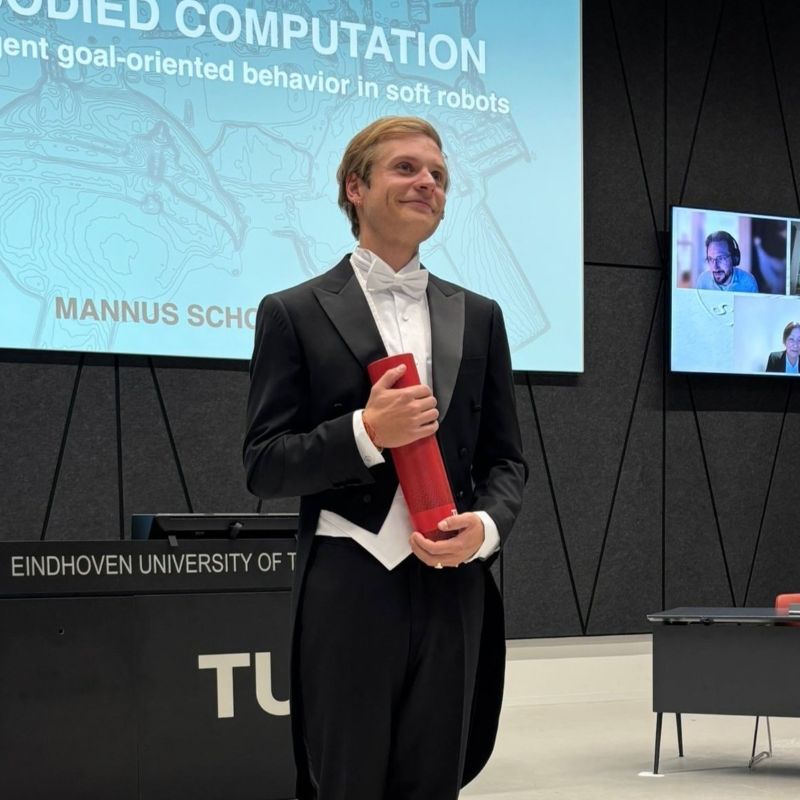
Mannus’ research revolved around providing soft robots with goal-oriented behavior, not by giving them a central brain, but in a decentralized manner. Mannus explains: “My inspiration comes from nature. Echinoderms, like starfish, have a decentralized brain. What you see is that the organism shows so-called emergent behavior. This means that each component only follows a set of basic rules, but when they all start interacting, you see complex behavior.”
Learn more
- To find out more about the soft robots Mannus developed
- View Mannus’ thesis in the AMOLF repository
