Lab Stories – AMOLF in 2025 highlights
About AMOLF
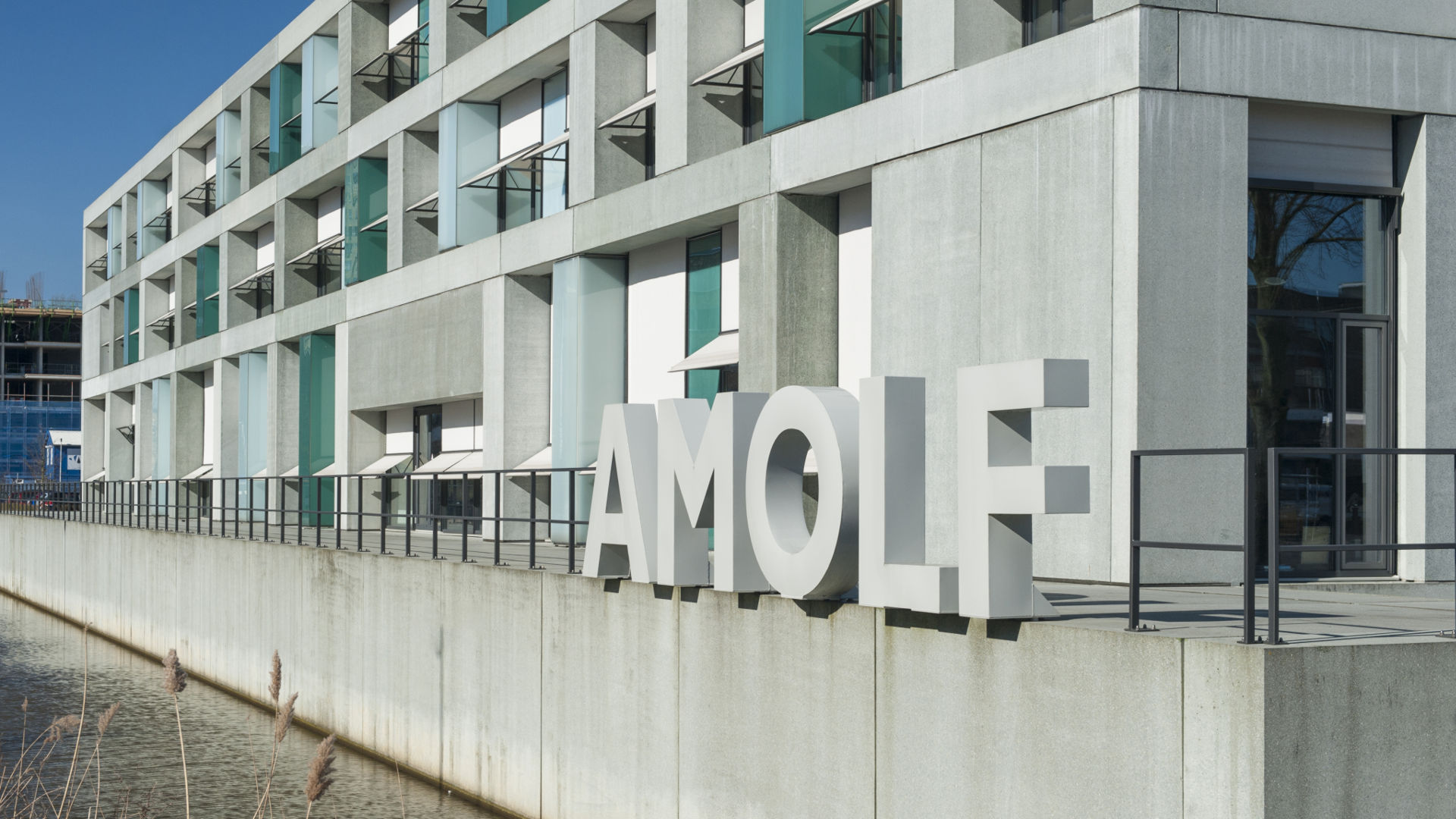
AMOLF is a national research institute that initiates and conducts leading fundamental research on the physics of complex matter, in partnership with academia and industry.
This leads to valuable insights and opportunities to create new functional materials and to find solutions to societal challenges in renewable energy, green ICT, and healthcare.
AMOLF’s research program comprises three interdisciplinary themes:
- Sustainable Energy Materials: efficient conversion of sunlight to electricity, chemicals, fuels, light, and heat.
- Information in Matter: mechanisms of information processing in inanimate and living matter, novel learning processes and adaptive materials.
- Autonomous Matter: organizational principles of autonomy in material systems, matter that exhibits embodied autonomy.
AMOLF plays a key organizing role in the national science landscape, renewing scientific directions, to help keep the Netherlands at the cutting edge worldwide. This translates into a constant influx of new talent and outflux of scientific leaders. AMOLF is part of NWO, the Dutch Research Council.
To stay updated, sign up here for the AMOLF newsletter.
Lab Stories – AMOLF 2025 highlights
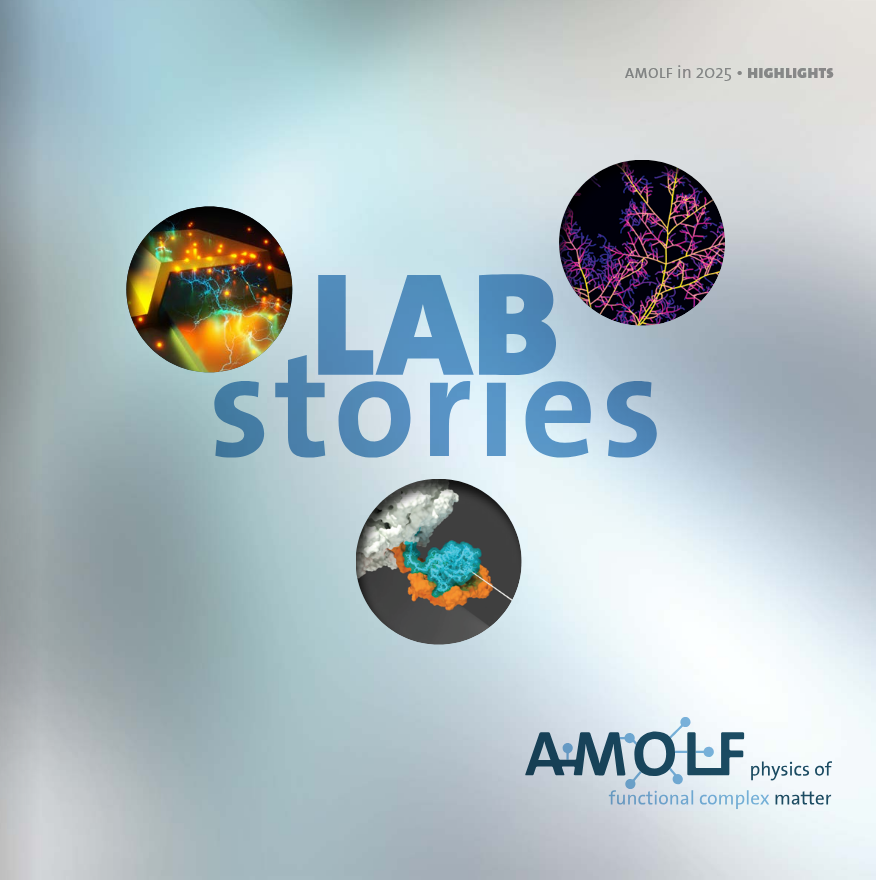
This is the first edition of Lab Stories, an annual publication that offers a selection of activities and achievements emerging from the research labs at AMOLF.
From scientific publications to new technical facilities and developments in our research programs, Lab Stories highlights milestones that reflect the diversity and impact of our work and people. It also presents key facts and figures about our institute.
This publication is intended for anyone interested in AMOLF – as a potential research partner in academia, government, or industry, as a prospective employer, or simply out of curiosity about science.
Directors’ perspectives on 2025
For AMOLF, 2025 was a year in which many earlier efforts came together. Looking back, Huib Bakker and Bruno Ehrler reflect on a period marked by strong scientific output and a changing world around the institute, as the directorship passed from Bakker to Ehrler at the start of 2026.
“2025 really was an ‘oogstjaar,’ a year of results”, Bakker says. “We saw many publications, a record number of PhD defenses, and major projects delivering impact.” He points to examples such as a publication on fungal networks in Nature, the completion of the custom-built Aretha imaging robot, and the HELIOS collaboration project aimed at developing a highly efficient perovskite solar cell. These achievements were only possible thanks to long-term, close collaboration between researchers and technical teams. “These are projects that took years to develop. Now you see everything come together.”
Ehrler places these achievements in a broader context. “We are operating in a very dynamic environment, where many things we took for granted are shifting. That creates uncertainty, but also opportunities.” He highlights areas such as artificial intelligence, sustainable energy, and sustainable materials. Because everything is shifting more than ever, agility and resilience have become increasingly important. AMOLF is well positioned to respond swiftly through its interdisciplinary and flexible approach.
For Bakker, the institute’s strength lies in its people. “There is a real sense of shared ownership. People work not just within their own group, but for AMOLF as a whole,” he says. “Maintaining that cohesion is central to the institute’s continued success.”
Ehrler sees clear priorities for 2026. “It’s about strengthening connections, with partners outside AMOLF, and also internally. Everyone who contributes should feel part of what we achieve together: scientists, technicians, and support staff.” At the same time, Ehrler is also discovering the institute from a new perspective. “I’m learning a lot, not just about the science, but about how the people of AMOLF work together. That is what I am most looking forward to.”
Huib Bakker: “I am very proud of both our scientific achievements and the people behind them, whose quality, dedication, and collaboration drive everything we accomplish.”
Enabling the energy transition – research theme Sustainable Energy Materials
Climate change is the greatest challenge facing society in the coming decades. Combining physics, nanotechnology, and materials science, the foundations for the next generation of sustainable energy technologies are being laid at AMOLF.
Below, we highlight two examples that illustrate research within our Sustainable Energy Materials theme.
A light sensor that thinks
Imagine a camera that can not only see light but also understand what it sees without a computer.
AMOLF PhD student Jeroen de Boer from the Hybrid Solar Cells group has developed the first step towards this vision: a tiny light sensor that also processes information, inspired by the human brain. His findings were published in the journal Device on December 17, 2025.
Unlike conventional sensors, the halide perovskite-based device briefly ‘remembers’ incoming light. The design mimics the way the brain works, sensing and processing information together. This allows it to handle visual information more efficiently.
Simulations of a network with thousands of these sensors showed that they could recognize images and moving objects with high accuracy while using very little energy. The innovation opens possibilities for intelligent self-contained imaging systems that work anywhere without needing a power grid.
SolarLab at AMOLF – a year of milestones
Two milestones marked the progress of SolarLab at AMOLF in 2025. In March, the first publication by Robin Schot, a SolarLab PhD student at AMOLF, was published. And in December, the eighth SolarLab PhD student was appointed at AMOLF, completing AMOLF’s SolarLab PhD group.
AMOLF’s first publication from a SolarLab student reveals how tiny differences in the texture and layer thickness of solar cells can cause light to bounce and be reabsorbed, subtly distorting measurements. This helps us making measurements more reliable and enabling the design of more efficient next-generation solar cells.
SolarLab is the academic research network within SolarNL, a nationwide collaboration between companies and research organizations for the development and production of solar cells and panels in the Netherlands. In total, 41 SolarLab PhD students are appointed at AMOLF, RUG, UvA, UU, TUD, TU/e, and UT.
“The beauty of this field is that deep scientific curiosity directly leads to real-world impact.”
Professor Esther Alarcón Lladó, Research Department Leader Sustainable Energy Materials
Sustainable Energy Materials research program
We explore how manipulating light, electrons, and ions in space and time leads to new ways to convert energy.
Ultimately, this will result in higher efficiency, better stability, and new functionality in solar cells, light-emitting diodes, and sustainable chemistry to convert energy.
Navigate to our website to learn more about our Sustainable Energy Materials research.
Looking back at 2025 in 10 timeline snapshots
These 10 highlights exemplify the many achievements of AMOLF researchers and staff throughout 2025.
- February 26 – Climate change
- Robotic imaging reveals how plant-fungal networks drive nutrient flows that enable large-scale CO₂ storage underground and support ecosystems.
- March 9 – Societal
- New technique, developed by AMOLF and UvA, that makes lead particles found in gunshot residue visible at the crime scene, helps solving crimes.
- May 23 – Climate change
- AMOLF, CWI, and DIFFER launch HELIOS project, an AI-guided materials discovery facility for solar energy materials.
- June 3 – Healthcare
- Breakthrough in heart technology: researchers took the first steps toward a ‘Hybrid heart’, combining soft robotics and biomaterials.
- Watch the video ‘LIMO Hybrid heart prototype’.
- July 15 – Climate change
- ERC Proof of Concept grant awarded to develop measuring technique for halide perovskites; extremely energy efficient solar materials.
- September 2 – Metamaterials
- The conference Metamaterials2025 brought together 400 researchers from around the world. The potential value and range of metamaterials applications is vast.
- Metamaterials are artificial materials engineered to exhibit unique properties not found in nature, enabling unprecedented control over waves in electromagnetism, acoustics, and mechanics. The range of potential applications is vast, e.g. in optical computing, autonomous soft robots, personalized medicine, and sustainable energy.
- September 4 – Healthcare
- Weaker intestinal cells are removed by pulling rather than pushing. This gives a new perspective on how intestinal dysfunction can lead to disease or infection.
- Watch the video ‘Pull rather than push’.
- September 25 – Diversity
- This year’s theme of AMOLF’s Diversity Day was ‘embracing cultural diversity’. The day featured talks, discussions, and activities fostering inclusion and mutual understanding.
- October 4 – Societal
- On Wetenschapsdag, AMOLF opened its doors to the public. Visitors were enthusiastic and eager to take part in lab tours, workshops, and hands-on activities.
- December 15 – Talent
- Kevin Peters received the prestigious Ehrenfest-Afanassjewa physics thesis prize for his research on nonlinear optical resonators.
How matter processes information – research theme Information in Matter
What if physical systems could learn, compute, and adapt, without traditional electronics? From brain-inspired systems to light-based computing, new paradigms are emerging that could reshape how we process and use information in both living and non-living matter.
Below, we highlight two examples that illustrate research within our Information in Matter theme.
Plant-fungal networks move CO₂ underground
A study published on February 26, 2025, in Nature reveals how plants and fungi form vast underground networks that act as hyper-efficient ‘supply chains’, moving billions of tons of CO₂ underground.
By tracking over half a million fungal ‘roadways’ with a custom-built robot designed and fabricated at AMOLF, researchers mapped how these networks grow and transport nutrients.
The team discovered that fungi grow in wave-like patterns while adapting their two-way resource ‘traffic’ in ways that enhance transport efficiency within a dynamically changing network. This allows them to optimize long-term gains, avoiding waste while strengthening connections between plants.
Fungi have spent hundreds of millions of years perfecting these underground networks and uncovering their operating principles could inspire new artificial ‘smart networks’ that flexibly adapt how they move matter and information on demand. Understanding these fungal mechanisms that regulate massive carbon movements underground could also help us develop new ways to tackle climate change.
AMOLF-ARCNL PhD collaboration
The joint PhD program between AMOLF and ARCNL combines fundamental physics and industrial relevance. The close-knit collaboration between the two institutes and ASML creates a fertile research environment.
Joint AMOLF-ARCNL PhD student Nick Feldman developed optical metasurfaces for measuring features far below the wavelength of light, a capability essential for semiconductor manufacturing. He used information theory concepts to determine the most effective nanophotonic structure (a very small pattern or material designed to control and manipulate light), the way light is sent in, and how the signal is read out. His experiment was published in Nature Communications in December 2025.
Nick’s work highlights how joint training programs can produce both high-impact science and researchers ready to bridge academia and industry.
“I’m fascinated by how physical systems, from cells to materials, can sense, store, and process information.”
Professor Pieter Rein ten Wolde, Research Department Leader Information in Matter
Information in Matter research program
We study how physical systems gather, process, and utilize information.
Using these principles, we explore how light, mechanics, and molecules can carry and process information, opening the way to new technologies such as smart and adaptive materials.
Navigate to our website to learn more about our Information in Matter research.
High-tech at AMOLF
Dr. Paula van Tijn, Institute Manager: “Researchers and technical staff work hand in hand to develop the custom equipment and infrastructure that drive our science.”
Custom knurling tool speeds up precision manufacturing
In September 2025, Lucy Karremans completed her graduation project at AMOLF’s instrument workshop, developing a custom knurling tool for a lathe used in precision manufacturing. Designed to accelerate the production of precision adjustment knobs, the tool significantly improves the efficiency of a common machining process used in scientific setups.
The project was carried out as part of Lucy’s studies at LiS (Leiden Instrument Makers School), where she graduated with the highest distinction, receiving a perfect 10! Starting from sketches, Lucy progressed to 3D models and 2D drawings, built the components herself in the workshop, and tested the assembled design. All within a few months, with guidance from her supervisors and support from colleagues at AMOLF. Following a successful internship, Lucy joined AMOLF’s Precision Manufacturing department.
Her design has also sparked interest beyond AMOLF, with potential for further development and valorization, including discussions with the lathe manufacturer.
Enabling nanoscale insight for light-driven chemistry research
As part of the EIC Pathfinder project reaCtor, AMOLF has developed a specialized microscope that is an essential contribution to this international collaboration. The project brings together partners from across Europe to develop a new type of flow reactor that uses light, rather than fossil energy, to drive chemical reactions, enabling more sustainable chemical processes.
At the core of reaCtor is a fiber-based plasmonic microreactor, in which optical fibers not only guide light but also host chemical reactions. Plasmonic nanoparticles on the fibers act as tiny antennas, concentrating light exactly where the chemistry happens and enhancing reaction efficiency. In this way, the project connects the world of optical fibers with that of chemical reactions. AMOLF researchers design these nanostructures and study how light interacts with them at the smallest scales.
The specialized microscope is crucial in this effort. It combines nanometer-precise positioning with a broad configuration of illumination options, enabling researchers to study how light interacts with these individual nanoparticles, adjusting their properties and driving chemical reactions.
The development of the setup is an example of a collaboration within AMOLF, bringing together researchers, group technicians, and engineering departments to create specialized equipment that connects fundamental understanding to real-world applications in sustainable chemistry.
HELIOS: Solar cell innovation driven by collaboration & technical expertise
An AMOLF collaboration with CWI and DIFFER has received funding from NWO-I (the institutes organization of NWO, the Dutch Research Council) to launch the joint project HELIOS: AI-guided materials discovery facility for solar energy materials. The aim of the project is to develop a highly efficient multilayered halide perovskite solar cell.
Within HELIOS, AMOLF will contribute its expertise in fundamental research on functional materials. CWI will lead the AI efforts, while DIFFER brings in strong systems engineering, machine learning, and data management capabilities.
The project involves a substantial contribution of AMOLF support staff: Electronics Engineering expertise builds custom complex electronic interfaces, the Mechanical Design department designs robotic interfaces, Precision Manufacturing will make custom parts for automated interfaces, Software Engineering will build and maintain automated systems, and ICT is involved due to the large volume of data generated.
Project leader Erik Garnett notes that the project faces a variety of practical challenges: “A regular solar cell has five layers, but we’re aiming for twenty layers that interact perfectly with each other.” The total budget for HELIOS is € 3.710.000 and the project is expected to run for 5 years.
How matter senses, adapts, and acts – research theme Autonomous Matter
What if materials could organize, adapt, learn, and act on their own, more like living cells than passive matter? We are exploring a new frontier where physics, chemistry, and biology converge to understand and create systems that act autonomously. Applications include adaptive chemical networks and programmable materials and organoids.
Below, we highlight two examples that illustrate research within our Information in Matter theme.
A soft robotic heart
What if an artificial heart could beat like the real thing? A new ‘Hybrid Heart’ brings that idea closer to reality, combining soft robotics with advanced biomaterials to mimic the body’s natural rhythm.
The device replaces rigid mechanics with a flexible, fabric-based structure and a soft robotic ‘muscle’ that drives blood flow. The system uses air pressure to mimic the contraction of heart muscles to power its motion. This simplifies the system and potentially improves reliability.
One of its most surprising innovations is inspired by something you might find in your kitchen: by mimicking the sputtering of a ketchup bottle, researchers can turn constant airflow into a steady, heartbeat-like rhythm.
Their study, published June 3, 2025, in Nature Communications showed promising results in early animal tests and could result in a new generation of safer and longer lasting artificial hearts.
Quantifying uncertainty in AI models
Computer algorithms based on neural networks can track cells in 3D with remarkable precision but they rarely tell you how much to trust what it says. A new algorithm developed by AMOLF researchers tackles that blind spot by building uncertainty directly into the analysis.
The method enables the AI model to express predictions with their probabilities. This makes it possible to calculate an expected error rate for every cell it tracks, and automatically flag uncertain datapoints for review or filtering. All without the need for time-consuming manual checks.
The cell tracking approach appeared on October 8, 2025 in Nature Methods. Not only does it pave the way for scaling up organoid research, as shown in a publication in Science on September 4, 2025, but also for AI applications that more accurately communicate their own limits.
“What drives me is understanding how living and engineered systems can learn, adapt, and function without central control.”
Professor Sander Tans, Research Department Leader Autonomous Matter
Autonomous Matter research program
We study how matter can perform complex functions independently.
Using these principles we design materials that self-organize, respond to their environment, and operate without centralized control.
Navigate to our website to learn more about our Autonomous Matter research.
AMOLF facts & figures in 2025
Science and outreach
- 114 peer-reviewed publications
- 17 published theses
- 32 awards and recognitions
- 3 research themes
- 19 research groups
- 305 talks at seminars and conferences
People
- 163 researchers
- 81 PhDs
- 14 professors
- 95 support staff (providing support for AMOLF and ARCNL)
- 54 guests
- 36% of our staff are women
- 94 new people
- 37 nationalities in our staff
Financial
- €15.773K NWO based funding
- €14.319K external projects
- €5.001K EU funded
- €3.286 NWO funded
- €5.150K government funded
- €882K universities, business and other
- 101 funded projects running
Let’s talk science
We welcome you to get in touch to explore challenges and opportunities together.
Professor Bruno Ehrler
- Institute Director
- Email: b.ehrler@amolf.nl
Professor Esther Alarcón Lladó
- Department Leader Sustainable Energy Materials
- Email: e.alarconllado@amolf.nl
Professor Pieter Rein ten Wolde
- Department Leader Information in Matter
- Email: p.t.wolde@amolf.nl
Professor Sander Tans
- Department Leader Autonomous Matter
- Email: s.tans@amolf.nl
Dr. Paula van Tijn
- Institute Manager
- Email: p.van.tijn@amolf.nl
Contact
- AMOLF
- Science Park 104
- 1098 XG Amsterdam
- Email: info@amolf.nl
- Phone: +31(0)20 7547100
