Nachi Stern awarded ERC Starting Grant to explore how matter learns
Why do brains learn, but rocks do not? Could a material one day adapt to its environment the way a living organism does? AMOLF group leader Dr. Nachi Stern has been awarded an ERC Starting Grant to investigate the physical laws of learning, in a project called, “Physical Learning in Dynamical Systems.”
Brains, computers, molds and more
We usually think of learning as something that happens in brains or computers. Yet many physical systems can also adapt based on experience. Slime molds reorganize their bodies when food sources change. Biological tissues remodel themselves after an injury. Some newly developed materials can even adapt their response to stimuli through repeated use. However, physics still has no general theory explaining how learning emerges in matter.
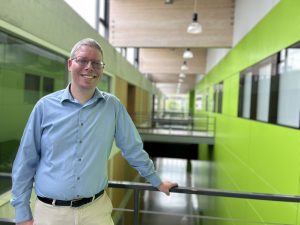
In a new project supported by an ERC Starting Grant, AMOLF group leader Dr. Nachi Stern will develop a new framework for understanding learning as a physical phenomenon. “Learning is everywhere in nature, not just in artificial intelligence,” says Nachi.
Rather than treating learning as a software algorithm running on a machine, he will explore whether learning itself can be understood in the language of physics. This could reveal fundamental principles, such as phase transitions, symmetry breaking, and collective behavior, that govern how physical systems adapt and learn.
Insights for the future of computing
The project, called “Physical Learning in Dynamical Systems” (PhyLDS), will bring together ideas from condensed matter physics, biology, and artificial intelligence. The team will study how simple local interactions can collectively give rise to learning, much as countless individual cells can together form a living organism, or a network of neurons can produce intelligent behavior. The goal is to uncover when learning is possible, when it fails, and what limits the ability of physical systems to adapt.
Ultimately, the project aims to lay the foundations for a new physics of adaptive matter: materials and systems that do not simply respond to their surroundings, but also change and learn from them. Such insights could help us better understand living systems and inspire future adaptive materials and energy-efficient computing technologies.
Contact
For more information about this research project, please contact Nachi Stern (email: N.Stern@amolf.nl).
