Research highlights

Intestinal surface cells pull rather than push

Cells on the inner surface of the intestine are replaced every few days. But, how does this work? It was always assumed that cells leave the intestinal surface because excess cells are pushed out. In a recent publication in the journal Science, researchers of the Hubrecht Institute and AMOLF show that this is not correct. In reality, the situation is exactly the opposite: the cells do not push, but pull at each other. These pulling forces lead to the removal of the weakest cells. This insight gives a new perspective on how a malfunctioning intestine can lead to disease or infection.

Pulling rather than pushing

The general idea was as follows: old and malfunctioning cells in the intestinal surface move to the exit like packages on a conveyor belt in a distribution center. Cells push each other out as they accumulate.

It turns out to be different. Researchers Daniel Krueger and Kasper Spoelstra show that the cells are not under pressure, but under tension. This tension arises from cells pulling at each other. This is comparable to a game of tug of war, but then played by cells and their neighbors. This tug of war game turns out to be essential to determine which cells are the weakest, and therefore need to leave the intestine.

Organoids

To get to these new insights, the research groups of Hans Clevers (Hubrecht Institute), Sander Tans (AMOLF) and Jeroen van Zon (AMOLF) work with so-called intestinal organoids. These are miniature versions of the intestine grown in the lab. One of the advantages of these organoids is that the researchers can easily manipulate and study them under a microscope.

Weak cells are out

Pulling forces exerted by cells on one another are essential for proper intestinal function. Cells that cannot generate sufficient pulling forces are removed from the intestine. These cells form a risk of improper closure of the barrier between the inside and outside of the intestines, which can lead to inflammation.

Experiments

Researchers Daniel and Kasper influenced the tug of war game played by cells in the organoids in different ways. Firstly, they conducted a series of experiments making cells weaker or stronger by manipulating them with light or by genetic manipulation. Whenever they combined stronger and weaker cells in one organoid, they noticed that weaker cells disappeared much more often from the organoid than stronger cells. Secondly, they conducted experiments weakening individual cells with a laser. Cells weakened in this manner tended to be extruded within one hour. Both experiments show that whenever cells are weaker than their neighbors – and are therefore losing the tug of war game – they are quickly removed from the intestine.

A closer look at intestinal diseases
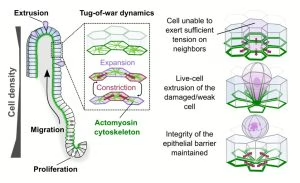
Tug-of-war-like competition between intestinal epithelial cells regulates cell extrusion. Cells in the intestinal epithelium proliferate in the crypt, migrate up the villus and typically extrude near the villus tip. In the villus, cells exert highly dynamic tension forces on their neighbors. Mechanically compromised cells that cannot exert sufficient tension extrude, in order to maintain the integrity of the intestinal epithelial barrier.

Pulling forces between cells in the intestinal surface also have medical consequences. The researchers also studied organoids with a genetic abnormality for the disease congenital tufting enteropathy. This disease has a negative effect on the development of the intestinal surface in newborns, sometimes leading to irreparable damage to the intestine. The researchers demonstrated that cells with this particular genetic abnormality show a disrupted tug of war behavior; they are exerting too much pulling force on each other.

Now that it is clear that cells leave the intestinal surface because of their ability to exert pulling forces, the researchers expect that follow-up studies will be conducted using tissue from patients with intestinal abnormalities, and also on forces between cells in other organs.

This research was a collaboration between the Hubrecht Institute, AMOLF and the Institute of Human Biology.

Read the Science publication

Reference

Daniel Krueger, Willem Kasper Spoelstra, Dirk Jan Mastebroek, Rutger Kok, Shanie Wu, Mike Nikolaev, Marie Bannier-Hélaouët, Nikolche Gjorevski, Matthias Lutolf, Johan van Es, Jeroen van Zon, Sander Tans, Hans Clevers, Epithelial tension controls intestinal cell extrusion, Science (2025).

science.org/doi/10.1126/science.adr8753
 

Share article
What's happening

Most recent news items

All news items
Joining forces to study perovskite interfaces
People and recognition

Joining forces to study perovskite interfaces

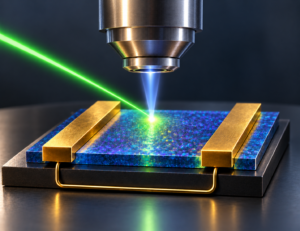
AMOLF group leaders Professor Wiebke Albrecht and Professor Bruno Ehrler have received an NWO ENW-M2 grant for their joint research project, The Dynamic Atomic Interface between Halide Perovskites and Metals. The insights gained will pave the way for sustainable, high-performance solar energy and information technology. Wiebke and Bruno will each hire a PhD student for this project. The grant amounts to €800.000.

Read news item
Wim Noorduin and Arian van Asten presenting their scientific journey
People and recognition

Wim Noorduin and Arian van Asten presenting their scientific journey

On October 8, Professor Wim Noorduin and his collaborator Professor Arian van Asten (University of Amsterdam) presented their scientific journey in a video to the audience at the ‘Avond van Wetenschap en Maatschappij’. They did so alongside the other nominees for the Huibregtsen Prize.

Read news item
Natural phenomena ‘hyperuniform disorder’ enables highly efficient, thin silicon solar cells
Research highlights

Natural phenomena ‘hyperuniform disorder’ enables highly efficient, thin silicon solar cells

Silicon solar panels are rigid and heavy, and many rooftops cannot support them. This creates a need for thin, flexible solar cells that can be integrated into building materials. However, making silicon solar cells thinner makes it harder to trap light inside the material. Researchers in the 3D Photovoltaics group found a fascinating way to overcome this challenge using a phenomenon called hyperuniform disorder. They publish their findings in the journal ACS Photonics.

The researchers were able to make highly efficient silicon solar cell materials that are 30 times thinner than conventional ones. They managed to do this by integrating a layer of nanometer sized structures on top of the material. Up close, this pattern looks random, but it is remarkably when you step back: no clumps, no gaps, and no repeating pattern. This is called hyperuniform disorder (or HUD).

Read news item
Off Road grant for a better understanding of intestinal cells that communicate with the immune system
People and recognition

Off Road grant for a better understanding of intestinal cells that communicate with the immune system

AMOLF postdoc Dr. Susanna Eli received an Off Road grant from ZonMw to investigate cells known as M cells in the gut lining that connect the intestine to the immune system. Understanding how M cells develop could ultimately contribute to better treatments for intestinal and immune-related diseases. The grant amounts to 100,000 euros.

Read news item
Stay informed

Get the latest research highlights, events, and news from our institute delivered to your inbox